.png)
Creators Build GEO Strategies to Get Discovered by Brands and Agencies in AI Search: Creator AI Visibility


TL;DR
We explain why creator AI visibility is becoming part of how brands and agencies discover partnership opportunities in AI search. Using the August 17, 2026 Digiday signal and current platform evidence, we show what is confirmed, what remains unproven, and how teams can measure creator activity against AI answers.
Creators Build GEO Strategies to Get Discovered by Brands and Agencies in AI Search: Creator AI Visibility
Creator marketing is now tied to a much larger discovery market. An IAB report projected U.S. creator ad spend at $37 billion in 2025, which helps explain why brands are looking for better ways to assess potential partners.
On August 17, 2026, Digiday reported that creators are adopting generative engine optimization, or GEO, to make themselves easier for brands and agencies to find in AI search. Creator AI visibility now depends on accurate identity signals, useful published evidence, and recurring checks of how AI systems describe and source a creator or partnered brand.
We cover what the reported shift means, what current platform announcements confirm, and how marketing teams can test its commercial value without mistaking visibility for proof of impact.
What Digiday’s August 17 Report Signals
The important development is not that a new ranking switch appeared overnight. The Google News listing frames the event as creators building GEO strategies to get found by brands and agencies. That is a commercial-discovery shift: creators are treating their public footprint as evidence that people and AI systems can understand.
We separate that reported trend from stronger claims about outcomes. A creator can make their identity, niche, audience, work, and partnership information easier to verify. That does not prove an AI answer engine will cite their content, recommend a brand partner, or influence revenue. Those are separate outcomes with different evidence.
For our analysis, creator activity is one potential external signal within a broader visibility system. Teams that need the evidence behind that distinction can review our creator impact evidence before assigning cause to a campaign.
How Creator AI Visibility Works Today
We see creator AI visibility emerging through three connected, but distinct, systems: official identity surfaces, platform-level partner discovery, and answer-engine representation. Treating them as one metric produces confident-looking reports that cannot tell a team what actually changed.
Official Creator Identity Signals
Google introduced Search Profiles for eligible creators in June 2026. The Search Profiles update says a profile can centralize a creator’s social accounts, websites, posts, and links, and may trigger or enhance a Knowledge Panel. For a creator, that means more control over the basic facts a prospective partner encounters during research.
For a brand, the value is accuracy. A consistent bio, current links, named areas of expertise, and well-organized work samples make it easier to distinguish the right creator from similarly named accounts or incomplete profiles. We would treat this as entity hygiene, not as a guaranteed citation tactic.
AI-Assisted Brand and Agency Matching
Platform discovery tools are becoming more explicit about the information they use. YouTube says its Creator Partnerships product gives advertisers access to more than 3 million creators, and that creators sharing channel insights surfaced 60% more in search results on average.
YouTube also says its matching technology will consider signals including audience similarity, organic brand mentions, and subscriber growth. Those details matter because they show brands and agencies are increasingly evaluating creators through structured evidence, not only through a follower count or a manually assembled media kit. We track this separately from multi-engine tracking, because a platform match is not the same thing as an AI-generated recommendation.
AI Search Creates More Detailed Discovery Queries
AI search experiences encourage people to ask longer, more contextual questions about products, categories, and people. Google says AI Overviews have more than 2.5 billion monthly active users and AI Mode has surpassed one billion, according to its website-owner update.
That scale makes the representation layer worth monitoring. A prospective agency may ask for creators in a narrow category, a buyer may seek expert-led product comparisons, or a marketer may research who has discussed a topic credibly. In each case, our focus is not merely whether a name appears. It is whether the surrounding answer is accurate, relevant, and supported by sources.
What Brands and Agencies Should Measure
The commercial question is simple: does creator work improve discovery and representation for the people who matter? We recommend starting with a baseline before a campaign, then measuring recurring results with the same prompts, engines, markets, and review rules.
| Outcome | What To Measure | What It Does Not Prove |
|---|---|---|
| Creator Discovery | Appearance in relevant platform search or partnership surfaces | Inclusion in AI answer citations |
| Brand Representation | Whether answers describe the brand and offer accurately | Incremental sales or campaign causality |
| Source Visibility | Which pages, videos, or publications are linked in answers | Whether every user sees the same result |
| Recommendation Context | The conditions under which a brand is suggested | A permanent ranking position |
Creator selection is already a measurement problem. IAB found that identifying the right creator was a leading challenge for buyers, while reputation and audience alignment were important decision factors. We use a prompt dataset to make that evaluation more concrete: it records what a buyer might ask and the evidence an answer actually surfaces.
The best operating model brings creator, content, SEO, and partnership teams into the same review. One team can validate campaign claims, another can improve the destination page, and another can inspect how the wording appears across answers. A recurring phrase-level sentiment audit helps keep the team focused on exact language instead of a vague visibility score.
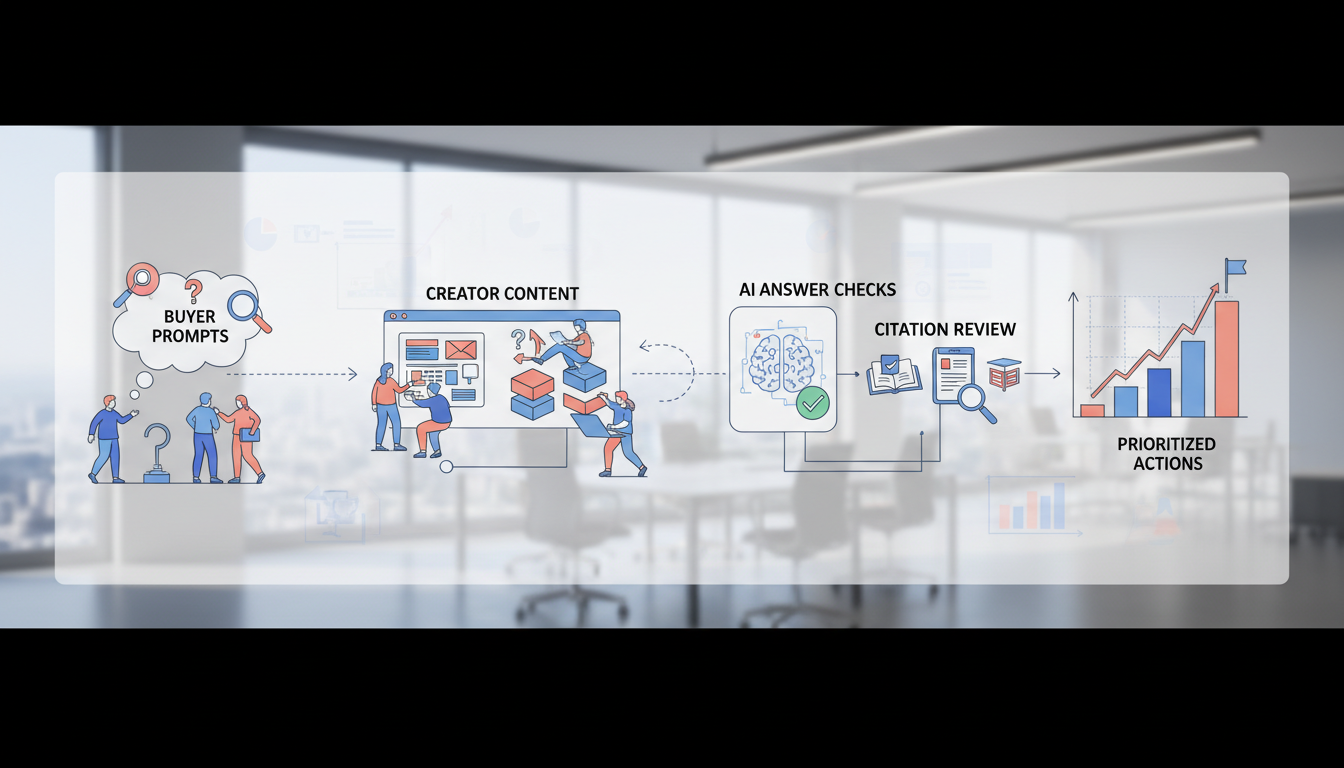
How to Test Creator Activity Against AI Answers
We recommend a controlled, evidence-first process. It will not make an inherently variable AI answer deterministic, but it will help a team distinguish a meaningful pattern from an anecdote.
Build a Commercial Prompt Set
Start with questions that reflect actual decisions, not only broad category phrases. Include recommendations, alternatives, comparisons, use cases, and creator or expert discovery queries where they genuinely fit the audience journey. Keep prompts in a shared record with the intended market, language, engine, and date.
A strong set includes both brand-neutral prompts and prompts that mention the category context a creator can credibly address. Our buyer prompt research workflow is useful here because it keeps the testing set tied to buyer language rather than internal campaign terminology.
Capture the Full Answer, Not Only a Mention
For every recurring check, preserve the complete response, the sources shown, the recommendation wording, and material factual claims. A mention without context can be neutral, negative, outdated, or unrelated to the commercial question.
| Signal | Useful Interpretation | Misleading Interpretation |
|---|---|---|
| Named Mention | The entity was recognized in this answer | The entity is broadly preferred |
| Linked Source | A source was surfaced for this answer | The source controls every future answer |
| Positive Description | The wording is favorable in context | Sentiment is universally positive |
| Repeated Appearance | The pattern merits investigation | A permanent rank has been achieved |
We use a multi-engine method because answers can vary by system, prompt wording, geography, and time. The right question is not, “Did we rank?” It is, “What changed in the answers our relevant audience is likely to see?”
Compare Before and After Carefully
Give a campaign enough time to publish, be discovered, and generate its own evidence trail. Then compare the same prompt set against the baseline. Look for changes in representation, source selection, recommendation context, and the prominence of the creator’s or brand’s expertise.
Google’s generative-AI Search reports can help website owners understand impressions, pages, countries, devices, and dates within its AI features. The Search Console reports are useful for Google Search visibility, while direct answer checks remain necessary for broader AI-search monitoring.
What GEO Cannot Promise
GEO is useful when it helps a team make accurate, original information easier to find and evaluate. It becomes risky when it is sold as a method for forcing citations, manufacturing authority, or bypassing the need for evidence.
We do not recommend publishing generic content just to create more surface area. Google’s current guidance emphasizes valuable, unique content and confirms that established SEO practices remain foundational in generative Search features. The practical implication is clear: make the creator’s expertise and the brand’s claims useful to a real reader first.
A phrase-level sentiment audit can reveal whether the language around a brand is accurate, qualified, and commercially useful. It cannot prove that a single creator activity caused an answer change, but it gives the team a clearer representation baseline to investigate.
Teams should also avoid blending together three different claims: a creator was easier for an agency to find, a brand appeared in an AI answer, and a campaign caused that result. Each may be valuable, but each requires separate measurement. The next action should be an editorial, technical, partnership, or evidence improvement, not an unsupported promise of guaranteed visibility.
Why PageLens.ai Makes Creator AI Visibility Measurable
At PageLens.ai, we help marketing, growth, SEO, and content teams turn creator activity into evidence they can review. We start with the prompts buyers actually use, then preserve the full answer, its sources, the language around the brand, and the engine, market, and date. That gives your team a defensible baseline before a creator campaign or content change goes live.
Our platform is useful when the question is not merely whether a name appeared, but whether AI answers describe the company accurately, recommend it in the right context, and cite sources that support the claim. We make it easier to compare recurring checks, find representation gaps, and turn observations into a prioritized editorial or partnership brief. Our method does not promise a fixed outcome, it makes learning visible and repeatable across campaigns. Use PageLens.ai to bring creator, SEO, and brand teams into a shared workflow. Book a demo
FAQs on Creator AI Visibility
Does Creator AI Visibility Guarantee AI Citations?
No. Creator AI visibility can improve available discovery evidence, but each engine independently decides whether to retrieve, summarize, link to, or recommend that evidence in context.
What Should a Brand Measure After a Creator Campaign?
Measure recurring prompt results, named mentions, recommendation context, linked sources, factual accuracy, and change over time. Keep the engine, market, date, and exact answer text for comparison.
Can We Use Creator Search Data as AI Visibility Data?
Not by itself. Platform discovery data can show commercial discoverability, while AI visibility requires checking user-facing answers, the displayed sources, the prompt context, and representation accuracy over time.