.png)
Do Creators Move AI Visibility? What the Evidence Shows About Creator Impact on AI Visibility


TL;DR
We found that creator impact on AI visibility is a credible hypothesis, not a proven causal lever. Third-party sources appear prominently in AI citations, but teams should measure creator programs against a documented baseline across engines before attributing gains. This article explains the confirmed news event, the evidence limits, and a practical testing workflow.
Do Creators Move AI Visibility? What the Evidence Shows About Creator Impact on AI Visibility
Marketing teams have reason to scrutinize creator work more closely: a 2026 citation audit reviewed more than 25 million links cited by leading AI assistants. That scale makes broad claims tempting, even though the evidence behind an individual creator partnership remains much thinner.
Creator impact on AI visibility is plausible, but not proven as a direct causal effect. We found reliable evidence that third-party sources and creator-adjacent surfaces are frequently cited, while the best available studies show correlation rather than lift. The useful response is to run controlled, cross-engine measurement before treating partnerships as a repeatable growth channel.
We explain the confirmed news event, separate evidence from inference, and show how marketing, growth, SEO, and content leaders can test whether creator work changes the answers their buyers receive.
What Happened in the Creator Visibility Story
The confirmed event was a partnership announced on 21 July 2026 between Zoom and journalist and podcaster Nayeema Raza. The official announcement confirms a six-part podcast series, social interview content, and a live conference conversation, while stating that the journalist’s work will remain editorially independent.
The August report that brought this story into the AI visibility conversation treated the partnership as a bet on credible third-party storytelling. That framing is useful, but it is not an outcome metric. No public pre-campaign baseline, post-campaign citation lift, partnership cost, or conversion result has been released, so we cannot responsibly call the partnership a demonstrated AI-search success.
For our audience, the lesson is not to dismiss creator relationships. It is to define what success would look like before a campaign begins, then monitor AI visibility at the prompt and source level rather than judging the investment from reach alone.
What Creator Impact on AI Visibility Evidence Shows
The strongest evidence points to a relationship between widespread third-party discussion and AI visibility. It does not yet isolate the incremental effect of a creator partnership from brand strength, existing demand, product quality, media coverage, or changes inside the answer engine.
The Strongest Observed Signal
A 75,000-brand analysis found that YouTube mentions had an approximately 0.737 correlation with AI visibility. Branded web mentions were also strongly associated, at 0.66 to 0.71, while backlinks and site page count showed much weaker relationships.
That is meaningful because video titles, descriptions, and transcripts can contain the kind of independent discussion buyers encounter through creators, reviewers, educators, and publishers. It is still correlation. Established brands may attract both more mentions and more AI visibility without one causing the other.
What Citation Audits Establish
A primary audit of AI citations found that earned media accounted for 84% of cited links, journalism represented 27%, and paid or advertorial content accounted for 0.3%. Across three editions, earned media stayed within an 82% to 89% range, which makes the broader third-party signal difficult to ignore.
The useful distinction is scope. Earned media includes journalism, review sites, forums, research, and community discussion as well as creator material. We should not translate a category-level citation pattern into a promise that any individual creator post will earn a citation. Instead, use citation context to identify which source types actually support answers in your category.
What Research Adds
A 2026 research paper examining 44 Web3 enterprises found that more popular voices and more concentrated creator communities were associated with higher-ranked exposure in generative-search citations. The authors describe the result as an exposure pattern, not a universal intervention result.
That distinction matters for every creator impact on AI visibility claim. We can use the finding to justify testing credible, topic-relevant voices, but we cannot use it to forecast a lift. We also need to track the language attached to each mention, because increased visibility is not automatically favorable visibility.
Why AI Engines May Produce Different Results
AI engines do not retrieve, cite, and summarize sources in identical ways. Google says its AI features can use query fan-out, which means one buyer question may trigger several related searches and draw from a wider set of supporting pages than a conventional result page.
Google’s 27 May 2026 update also brought Preferred Sources into AI Overviews and AI Mode. More than 345,000 unique sources had been selected at that point, and users were twice as likely to click a chosen source, according to Google’s announcement. That is a user-preference feature, not a creator-citation tactic, but it reinforces that source trust and source choice can affect discovery.
The report also cited a 2026 analysis of 89,000 professional-network URLs that showed a split by engine: one engine cited company pages 59% of the time, while two others cited individual members 59% of the time. We should treat that as a reminder to separate independent creator material, executive thought leadership, company publishing, video, and editorial coverage in our measurement.
| Source Type | What It Can Add | What It Cannot Prove Alone | What We Should Track |
|---|---|---|---|
| Independent Creator Content | Perspective, demonstrations, and topical discussion | Incremental citation lift | Mention, citation, sentiment, and source URL |
| Company Publishing | Product accuracy and owned expertise | Independent validation | Citation rate and recommendation language |
| Editorial Coverage | Third-party reporting and contextual trust | Creator-specific influence | Citation share and topic association |
| Executive Content | Named expertise and practical experience | Broad market consensus | Engine-specific citations and framing |
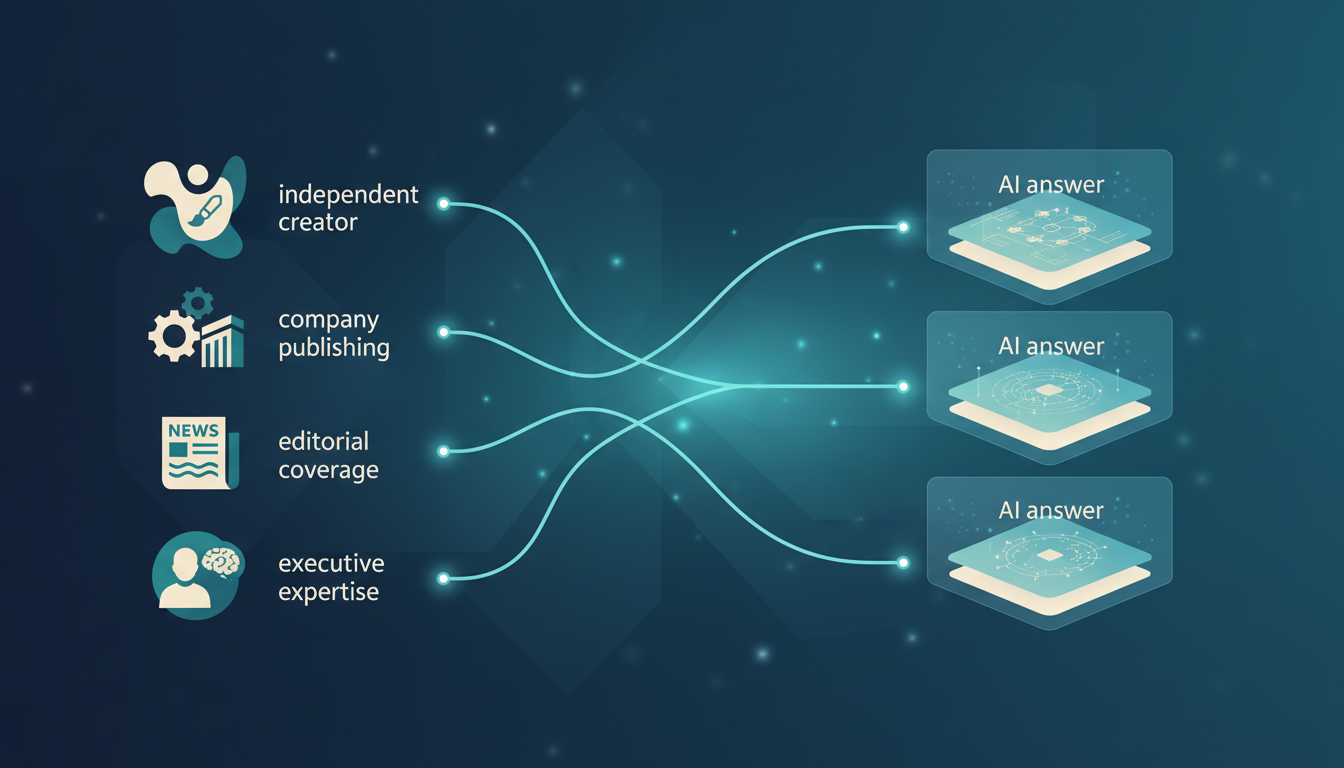
This is why a single blended score can hide the real answer. Use a cross-engine method to see whether a creator asset is cited, whether it shapes language without receiving a link, and whether the effect appears consistently across the engines that matter to your buyers.
How We Would Measure a Creator Program
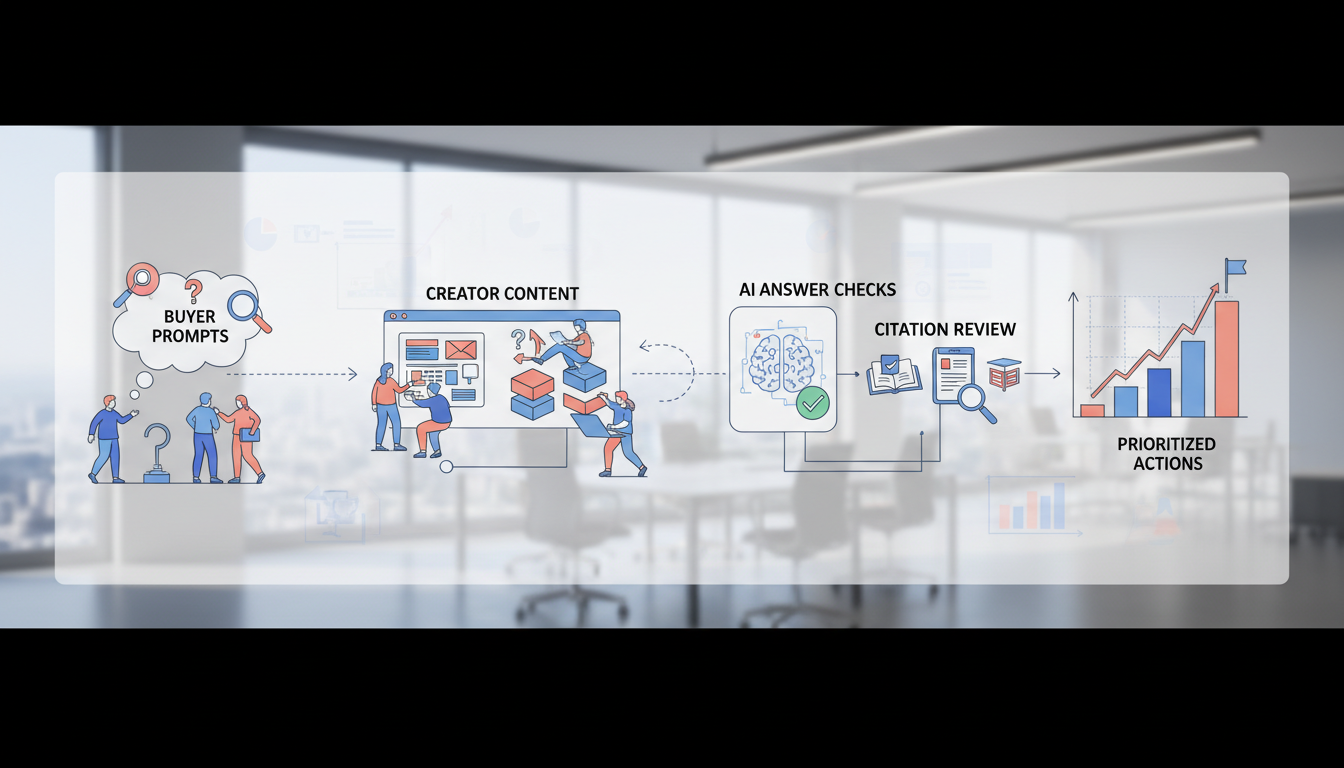
A defensible test starts before creator content goes live. We need a stable set of buyer prompts, a pre-campaign record of responses, and a way to distinguish exposure from a meaningful change in how an answer engine describes or recommends the brand.
Google’s own guidance is helpful here: AI-feature eligibility still depends on indexable, useful pages and core SEO practices, not special markup or shortcuts. The official guidance gives us a useful guardrail: creator work should complement strong owned content, not replace it.
Build a Relevant Prompt Set
Start with category questions, comparisons, use-case questions, objections, and recommendation prompts that reflect how prospects make decisions. A focused prompt dataset is more useful than a long list of generic keywords because it lets us compare the same questions before, during, and after the campaign.
Keep prompts stable for the measurement period, while recording engine, location, language, date, and the exact wording used. If the question changes each week, the result can reflect prompt drift rather than a true visibility change.
Record More Than Mentions
For every answer, capture whether the brand appears, whether it is recommended, which URLs are cited, and the wording used to describe it. We should also classify each source as owned, editorial, creator, community, company page, or other third party.
This makes the evidence actionable. Teams can use a multi-engine tracking process to compare a creator asset’s visibility across engines while retaining the source-level evidence behind the result.
Compare Against a Real Baseline
A baseline should include multiple observations before activation, not a single screenshot. We then compare the same prompt set over time, annotate product launches and major news events, and inspect whether the cited source actually changed.
| Measurement Stage | What We Record | Decision It Supports |
|---|---|---|
| Before Activation | Prompt answers, citations, mentions, and wording | Whether a measurable gap exists |
| During Activation | New source appearances and answer changes | Whether movement aligns with campaign timing |
| After Activation | Durable citation and recommendation patterns | Whether the effect persists |
| Review | Alternative explanations and engine changes | Whether to scale, revise, or stop |

Finally, audit any apparent result before scaling spend. A rise in visibility can be positive, neutral, or harmful depending on the answer’s wording. We should examine the exact recommendation language, not just the count of appearances.
Measure Creator Impact with PageLens.ai
At PageLens.ai, we help marketing, growth, SEO, and content teams turn uncertain AI visibility signals into a repeatable operating rhythm. Our workflow starts with the buyer prompts that matter, then records mentions, citations, recommendation language, source type, and answer wording across the engines your audience uses. That lets us distinguish a creator campaign that changed the conversation from one that merely produced reach.
We do not ask teams to treat a single citation as a win or a dashboard score as proof. We help them set baselines, retain the underlying responses, compare owned and third-party sources, and decide what to publish, brief, or test next. The result is a practical measurement method for leaders who need to explain progress, uncertainty, and investment choices without hype. If your team needs that measurement discipline with confidence and speed today, Book a demo
FAQs on Creator Impact on AI Visibility
Do Creators Directly Cause AI Visibility Gains?
No. Current evidence links third-party discussion, video mentions, and AI citations, but cannot isolate creator activity from reputation, demand, product quality, media coverage, or platform changes.
How Should We Measure Creator Impact on AI Visibility?
Start with a documented baseline for the same buyer prompts, then log mentions, citations, recommendation language, source types, and response wording across relevant engines over time.
Should We Invest in Creator Work for AI Visibility?
Not automatically. Creator work deserves investment when it produces credible, relevant information and your tracked prompts show durable improvements beyond normal variation or broader search changes.