.png)
AI Visibility Benchmark Shows Operators Who AI Recommends, and Why


TL;DR
We found that the April 2026 restaurant recommendation snapshot aligns with stronger current evidence: AI visibility depends on documented facts, review volume, owned pages, and third-party signals, but varies by engine and prompt. We explain what the reporting established, where it stops, and how teams can measure recommendations and citations without mistaking a one-off answer for a ranking.
AI Visibility Benchmark Shows Operators Who AI Recommends, and Why
In a 2025 survey of more than 37,000 consumers across 33 markets, 67% said they had already used AI in some part of travel, including restaurant discovery and trip planning, according to a travel survey.
Hospitality reporting that examined restaurant recommendations across ChatGPT, Gemini, and Claude is directionally supported by current evidence: AI systems often surface venues with stronger documentation, reviews, current facts, and third-party corroboration. The change for operators is to measure recommendation frequency, position, and cited sources across repeated local buyer prompts, rather than chase one-off answers.
We explain what the reported benchmark found, what independent research can and cannot confirm, and how marketing teams can turn AI answers into a measurable visibility workflow.
What Happened in the Restaurant AI Visibility Benchmark
The Hospitality & Catering News signal concerned a restaurant recommendation snapshot published on 29 April 2026. It matters because it shifts the question from “Does AI know our brand?” to a more useful one: “When a buyer asks a realistic local question, does the answer recommend us, and what public evidence supports that recommendation?”
The underlying reported snapshot tested restaurant recommendations in Budapest, Bucharest, and Vienna across three AI systems. Its authors varied English and local-language prompts, then asked follow-up questions about sources, recommendation logic, and less tourist-focused alternatives. They observed that heritage venues and businesses with large review footprints tended to appear prominently.
That is an observation, not a definitive industry ranking. The report describes its work as a small test and does not publicly disclose a complete response count, raw answer set, or reproducible scoring formula. We would not turn it into a claim that one venue is objectively better than another. We would use it as a timely example of why hospitality teams need a disciplined way to observe what AI systems actually return.
For a useful baseline, prompts should mirror how buyers make choices: “best place for a team dinner,” “quiet hotel restaurant near the station,” or “caterer for a vegetarian conference lunch.” Our guide to buyer prompts explains why prompt context must be recorded before any result can be compared.

What Independent Research Confirms
Independent evidence does not validate the snapshot’s unnamed winners. It does, however, support the broader idea that recommendation visibility is selective, evidence-driven, and different across systems.
A 2026 preprint examined 4,776 cafes, restaurants, and bars across two Bali markets, using 2,208 search-grounded responses from four AI systems and 96 persona-conditioned prompts. It found that 85.6% of venues were never recommended by any tested system. The study is a transparent preprint, not peer-reviewed research, so its geography and methods should not be generalized without qualification. Still, its restaurant audit offers unusually detailed evidence for the problem the reported benchmark raised.
| Finding | What It Suggests | Evidence Boundary |
|---|---|---|
| 85.6% of venues were never recommended | Most venues may not enter the AI consideration set | Two Bali markets, not a global estimate |
| Owned website association: 1.92 odds ratio | Clear, accessible first-party evidence can help a venue enter answers | Association is not proof of causation |
| Review-volume association: 1.64 odds ratio | Documentation volume may matter before rank position | Review quality and audience fit still matter |
| Top-20 overlap: 0.33 to 0.54 | One engine cannot stand in for all AI discovery | Results depend on tested systems and prompts |
The same study found that listed pricing and third-party mentions were associated with entry into answers, while star rating was associated with first position among venues already recommended. That distinction matters. Getting into an answer and becoming the first recommendation may rely on different evidence. Teams need multi-engine tracking because visibility in one assistant is not a reliable proxy for visibility everywhere.
Hospitality research points in a similar direction. A 2025 study of 145 consistently top-ranked hotel properties used 810 prompts across three AI systems. It reported that online travel agencies received 55.3% of cited sources, hotel websites received 13.6%, and all recommended properties had strong ratings and high review volume. The hotel study should be treated as vendor-led research, but its disclosed methodology and results reinforce the need to audit both owned information and the external pages AI systems cite.
How to Measure AI Visibility Without Chasing Screenshots
AI visibility is not a single score or a screenshot of a favorable answer. It is a repeatable record of whether a brand is mentioned, recommended, accurately described, and supported by cited evidence for a defined set of prompts.
Google explains that its AI search experiences can use query fan-out, issuing related searches across subtopics and sources before generating a response. That means a seemingly simple hospitality prompt can draw on several pages and entities. Its official guidance also makes clear that sound SEO fundamentals, crawlable content, reliable information, and genuine usefulness remain the foundation.
Build a Prompt Set That Reflects Real Demand
Start with discovery, comparison, occasion, location, and practical-constraint prompts. Record the language, city, customer type, and exact wording for every test. A restaurant prompt from a tourist, a local parent, and a corporate event planner should not be treated as the same buyer question.
Use prompt research to build the set around audience intent rather than keyword volume alone. That makes the benchmark suitable for decisions about pages, listings, reputation work, and local content.
Capture Recommendation Evidence, Not Just Mentions
For each response, record whether the business was named, whether it was affirmatively recommended, its order of appearance, cited URLs, recommendation language, and factual accuracy. A mention inside a long list is not equal to a first-position recommendation supported by relevant sources.
Keep each result connected to the prompt and its cited evidence. That makes it possible to distinguish an accurate recommendation from an answer that only appears favorable because it repeats incomplete or outdated third-party information.
Repeat Across Engines and Time
Repeat prompts on a stated schedule and report the sampling rules. The restaurant preprint found low overlap between systems, while its test-retest work suggested that variation is a measurement feature teams must account for, not a reason to abandon measurement.
Our approach to citation context keeps the answer and its evidence together. That is essential when a model names a business but cites a third-party listing with outdated hours, missing pricing, or an incomplete description.
OpenAI similarly says no site can guarantee top placement in ChatGPT Search, although public pages must allow its search crawler to be eligible for inclusion. Its search guidance is a useful reminder that technical accessibility is necessary but does not establish recommendation preference.
Turn Findings into Assigned Work
A good benchmark ends with an owner and a next action. Marketing may own evidence-rich pages, operations may own hours and availability, local teams may own business profiles, and communications may own external proof and corrections.
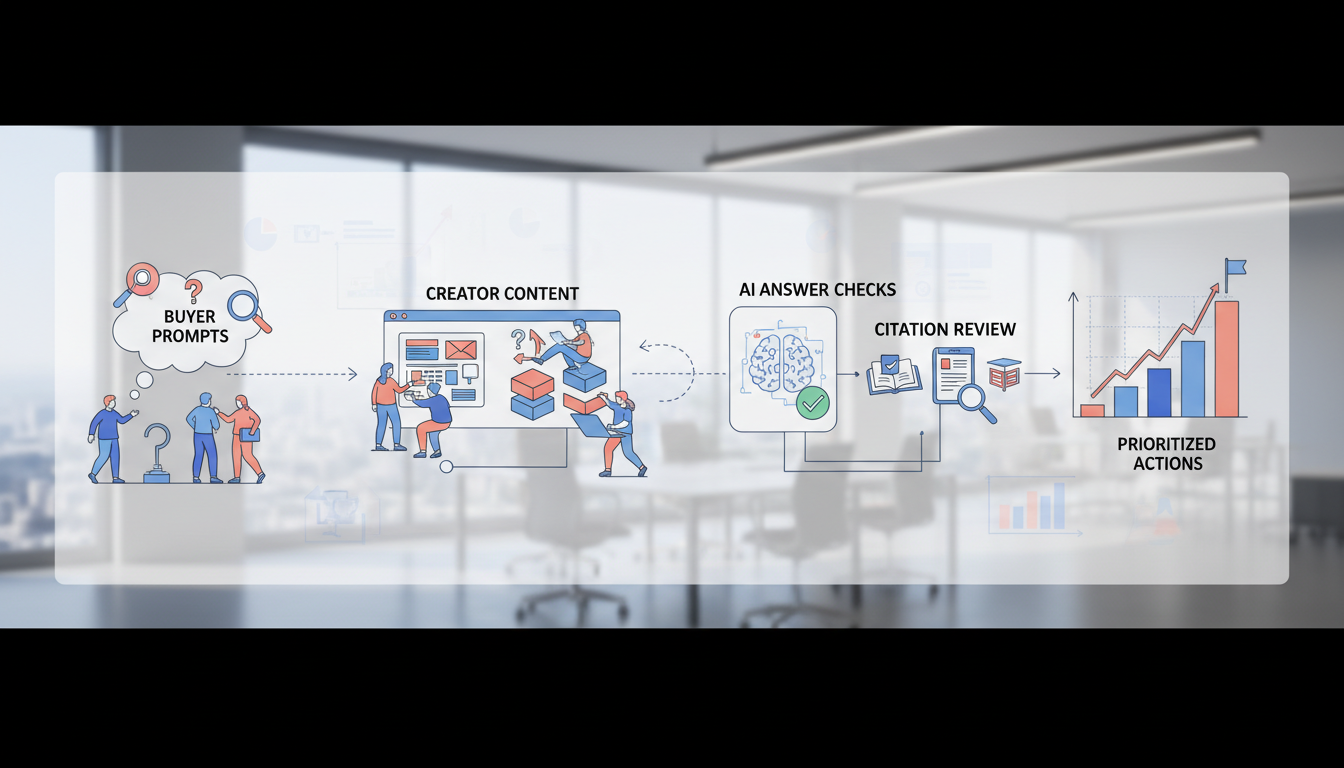
Use an AI visibility system to prioritize recurring gaps. The goal is not to manufacture mentions. It is to make the facts buyers need clear, current, accessible, and consistently supported wherever the answer draws its evidence.
What the Benchmark Changes for Hospitality Teams
The headline is not that AI has replaced search. It has not. The practical shift is that increasingly common discovery questions can produce a short recommendation set, so omission becomes easier to miss and more important to investigate.
For hospitality brands, AI visibility work should connect answer-level evidence to the customer journey. A team that only tracks organic ranking cannot see whether its venue is recommended for a buyer’s stated need. A team that only tracks a broad AI score cannot see whether the recommendation is accurate, favorable, or grounded in the right sources. The right dashboard metrics make those differences visible.
| Observed Result | Likely Issue To Investigate | Practical Next Step | Useful Metric |
|---|---|---|---|
| Brand is absent | Weak evidence, poor prompt fit, or engine variation | Audit pages and recurring third-party sources | Recommendation rate |
| Brand is mentioned but not recommended | Recognition without a compelling fit | Strengthen proof for high-intent use cases | Mention-to-recommendation rate |
| Details are inaccurate | Stale owned or external information | Correct source pages and listings | Factual-error rate |
| One engine performs better | Different retrieval and source patterns | Compare cited evidence by engine | Engine-level visibility |
Google launched dedicated generative AI performance reporting in Search Console in June 2026, with impressions, pages, countries, devices, and dates for eligible generative experiences. Its new report is useful for Google-specific visibility, but it does not replace answer-level monitoring across other systems.
The highest-value habit is to review the actual language around a brand. A favorable mention can still be unsuitable if the model assigns the wrong customer segment, price point, location, or service capability. Our framework for recommendation language helps teams inspect that context before deciding what to fix.
How PageLens.ai Makes AI Visibility Measurable
At PageLens.ai, we help marketing, growth, and content teams turn uncertain AI answers into a documented operating rhythm. We start with the prompts buyers actually use, retain the exact wording and context, and compare how answers change across engines and over time. Our platform keeps the evidence connected: whether a brand was mentioned, recommended, described accurately, or supported by cited sources. That makes it easier to assign action to the team that owns the underlying fact, page, listing, or earned proof, then measure whether the answer changes after the fix. We do not ask teams to confuse a dashboard score with a strategy. We help them keep a defensible record of what AI says, what evidence shaped it, and what to improve next. If you need that discipline across a growing prompt set, with clear ownership, regular review, and action-ready reporting in every market, Book a demo
FAQs on AI Visibility
What Is AI Visibility?
AI visibility measures brand presence in generated answers, including appearances, recommendations, position, and the cited sources that directly support the information presented to buyers.
Why Must Hospitality Teams Repeat Prompts?
Repeating prompts shows whether recommendations persist across runs, engines, languages, and contexts. It prevents teams from mistaking one unusually favorable or unfavorable response for evidence.
Can One Good Listing Create Better Recommendations?
One accurate listing helps, but recommendations usually draw on a wider evidence set: owned pages, reviews, current facts, third-party coverage, and prompt-specific relevance for buyers.
What Should Teams Fix First?
Fix recurring factual errors and missing evidence for high-intent questions first. Then improve pages and sources that appear repeatedly around prompts tied to revenue goals.