.png)


TL;DR
We see a new constraint for travel marketers: 69% of surveyed travelers say AI search summaries can be enough to make an informed travel choice. That makes AI visibility for travel brands a consideration-stage issue, not proof of booking intent. We explain the trust gap and give teams a measured way to check, correct, and monitor the answers travelers see.
AI Visibility for Travel Brands Starts in AI Summaries
Travel planning is moving into AI summaries before travelers open a booking site. A global survey released on April 15, 2026 found that 69% of respondents considered AI search summaries sufficient to make an informed travel choice without more research.
On April 15, 2026, a global travel survey found that 69% of travelers consider an AI search summary sufficient to make a travel choice without further research. For AI visibility for travel brands, the immediate consequence is clear: the facts and distinctions an assistant surfaces can shape consideration before a traveler ever reaches a booking page.
We explain what the finding confirms, where trust still breaks down, and how marketing teams can measure the answers that influence early travel decisions.
The Confirmed Shift Is in Travel Discovery
The result is significant because it concerns the research stage, where a destination, property, or service first earns consideration. The report methodology covered 6,000 leisure and business travelers in Australia, China, Germany, India, the UK, and the US during the fourth quarter of 2025. It is self-reported survey evidence, not a record of completed bookings, but it still shows how quickly the first stop in a travel journey is changing.
The Finding Is About Decision Confidence
A traveler who accepts a summary as sufficient may never compare every option in a conventional results page. That raises the value of clear entity facts: location, room attributes, policies, local context, availability, and the distinctions that make a brand appropriate for a particular trip.
For marketers, the immediate risk is not simply being absent from an answer. It is being described incompletely, grouped with the wrong alternatives, or left out when an answer engine compresses a high-intent choice into a few recommendations.
Chatbots Are Now an Inspiration Channel
The same research found chatbot use for travel inspiration had risen from 6% five years earlier to 18%. AI use was reported across planning and research, inspiration and destination discovery, and in-trip activity. That is enough to make AI visibility a practical discovery channel, especially for brands that depend on category, location, and experience-led prompts.
Visibility Influences Discovery, Not Automatic Booking
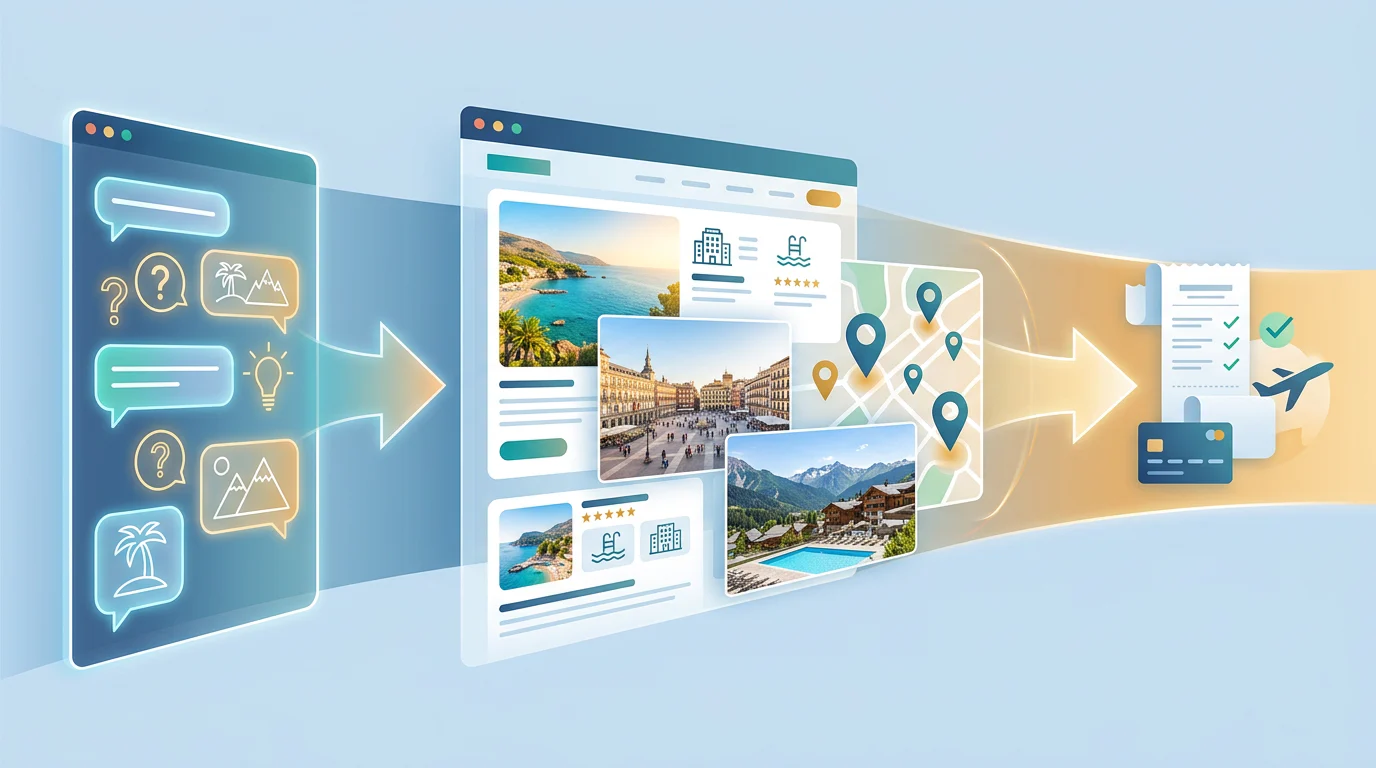
The strongest interpretation is not that travelers have handed booking decisions to AI. It is that a concise answer can now establish the shortlist. In a late-June survey of 1,000 US consumers, a confidence survey found 53% would trust an AI-powered tool to recommend a flight, while roughly 72% said AI-powered booking causes stress or anxiety. Only 8% said they used AI to book a final trip.
The Funnel Has Split
Separate surveys should not be treated as one conversion dataset, but together they show a consistent pattern: assistance is welcome earlier than autonomy.
| Travel Stage | Confirmed Signal | Practical Meaning |
|---|---|---|
| Discovery | 69% said an AI summary could be sufficient for an informed choice | Accurate representation can affect consideration |
| Recommendation | 53% would trust AI to recommend a flight | Relevant, specific information matters before the click |
| Booking | 8% reported using AI for final booking | Trust, pricing, policies, and support still determine conversion |
A broader booking survey published in April reached a similar conclusion: 68% preferred a trusted travel brand over a chatbot or agent for booking, and 66% would not trust an AI assistant to buy on their behalf.
Trust Is the Handoff Requirement
This is where AI visibility for travel brands becomes more than a mention-counting exercise. A favorable answer can create demand, but it cannot compensate for unclear cancellation terms, stale rate information, weak service proof, or a difficult booking journey. Teams should measure answer presence and answer quality separately from qualified visits and conversion.
How to Measure AI Visibility for Travel Brands
We recommend treating AI answers as an observable part of the travel funnel, not as a black box. Google’s AI search guidance is clear that foundational SEO still applies: content must be crawlable, important details should be present as text, internal linking matters, and structured data must match visible page content.
Publish Decision-Ready Facts
Prioritize pages that can resolve a traveler’s uncertainty: property and destination pages, room attributes, price inclusions, accessibility information, cancellation terms, and local experience details. For hotel sites, Google’s hotel data guidance specifically supports machine-readable price, room, offer, availability, and amenity information for price validation.
Run a Stable Prompt Audit
Build a compact prompt set from the choices travelers actually make: destination fit, family needs, accessibility, specific amenities, local experiences, seasonal conditions, and cancellation flexibility. Record whether the answer mentions, recommends, or omits the brand, then use a repeatable process to monitor AI visibility over time.
Separate Presence from Performance
A mention alone is not a business outcome. Capture the recommendation language, cited sources, factual accuracy, and whether the answer reflects the positioning your team intends. Then compare visibility changes with qualified traffic and conversion signals.
Skip Unsupported Shortcuts
Do not create special files or markup solely for AI search, and do not multiply thin pages for prompt variants. A stronger response is to keep the pages travelers need accurate, specific, crawlable, and useful enough to deserve inclusion.
Measure the Shift with PageLens.ai
At PageLens.ai, we help marketing teams turn this news signal into a repeatable measurement practice. We define the prompts that matter across discovery, comparison, and booking, then monitor whether AI answers mention your brand, recommend it, cite reliable pages, or repeat inaccurate claims. Our workflow keeps answer visibility separate from business outcomes, so teams can prioritize corrections without mistaking a mention for revenue. It also gives content, SEO, and growth leaders shared citation context when a product fact, policy, or positioning message changes. If AI summaries are becoming a first impression, they deserve the same disciplined measurement as search performance. Book a demo
FAQs on AI Visibility for Travel Brands
Do AI Summaries Drive Travel Bookings?
No. AI summaries can shape consideration, but booking still relies on accurate rates, clear policies, payment confidence, and human support when travelers need certainty or assistance.
How Should Travel Teams Measure AI Visibility?
Use stable traveler prompts, then record brand presence, recommendation wording, citations, and factual accuracy. Compare these observations with qualified visits and conversion signals over time.