.png)
What Are B2B Buyers Asking AI Before Launch? B2B Buyer Prompt Research


TL;DR
Build a privacy-safe B2B buyer prompt research method that separates observed questions from modeled prompts before launch.
What Are B2B Buyers Asking AI Before Launch? B2B Buyer Prompt Research
Before a sales conversation, 61% of B2B buyers prefer an overall rep-free buying experience. That makes pre-launch buyer research a content and positioning problem, not just a sales-enablement exercise.
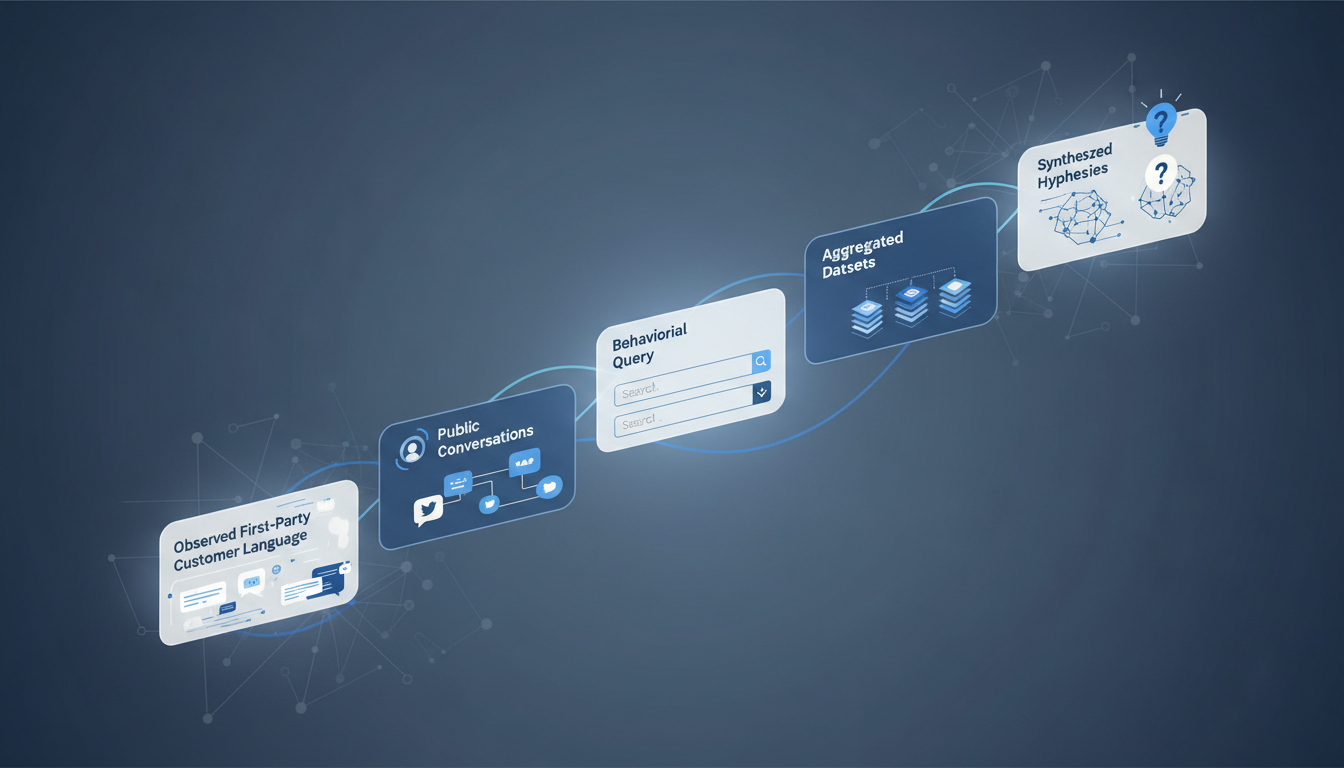
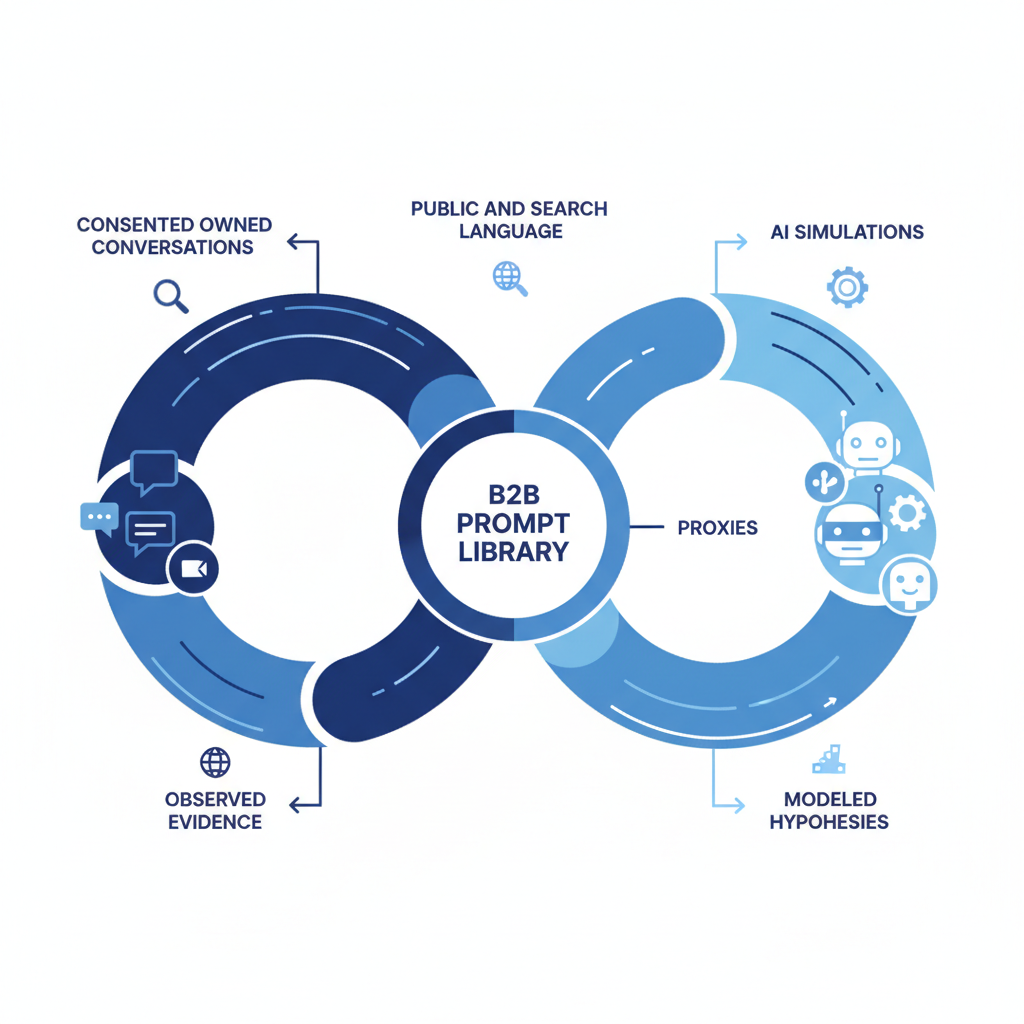
You cannot see private prompts that buyers type into ChatGPT or other AI tools. Before launch, B2B buyer prompt research should combine consented first-party conversations, public community language, search data, and structured simulation. Label each question as observed, derived, or modeled, then prioritize it by buyer stage, decision risk, product relevance, and confidence.
This guide explains what prompt-research tools can actually know, how to build a source-backed library, and how to validate it before your product reaches market.
Can Buyer Prompts Be Observed?
The answer depends on what “observed” means. A buyer’s private conversation inside an external AI interface is not a market-research dataset available for inspection. Treating modeled questions, search terms, or sales-call language as proof of private AI behavior makes the research look more certain than it is.
What you can observe is valuable: questions that buyers ask your team, terms they use in owned chat experiences, queries on your site, and language they post publicly. Those sources reveal the problem, stakes, and constraints buyers carry into research. They just do not prove the exact prompt used in a separate AI conversation.
A platform’s own private workspace guidance illustrates the boundary: individual business-workspace chat histories are not automatically visible to other members, and usage analytics do not grant transcript access. A credible workflow therefore starts by documenting access, consent, and provenance before it starts generating prompts.
That distinction is what separates useful prompt research from an expanded keyword list. For a deeper explanation of the difference, see our keyword and prompt research guide.
Which Evidence Sources Are Reliable?
Reliable does not mean perfect. It means the team can say where a question came from, what it represents, and what it cannot establish. First-party sources usually give the richest buyer language, while modeled sources help expose gaps worth testing.
Use interviews, discovery calls, sales notes, win and loss records, support conversations, owned chat logs, on-site search, and public community discussions to collect evidence. Preserve the phrase that matters, including qualifiers such as role, deadline, integration, budget, security concern, or implementation risk. A buyer who says, “We need this before renewal, but legal will block it without SSO,” has provided more usable direction than a generic category query.
| Evidence Type | Examples | What It Establishes | What It Does Not Establish | Library Label |
|---|---|---|---|---|
| Observed Buyer Language | Interviews, calls, tickets, public discussions | Real phrasing, objections, and constraints | That the phrase was typed into an AI chat | Observed Language |
| Observed AI Prompt | Consented owned-chat or API logs | Exact prompt text in that environment | Category-wide demand | Observed Prompt |
| Search Proxy | Site search and search-performance data | Search wording and recurring topics | Private AI-chat activity | Search Proxy |
| Modeled Prompt | Persona simulation and prompt expansion | A testable hypothesis | Real buyer frequency | Modeled |
| AI-Answer Observation | Repeated prompt tests | How a model currently answers | What buyers privately asked | Model Response |
When processing conversations, use the minimum excerpt needed and remove personal details that do not affect classification. The ICO data minimization guidance says personal data should be relevant and limited to what is necessary for the stated purpose. Consent, anonymization, retention, and aggregation rules should be reviewed with your privacy owner for the jurisdictions you serve.
Search data belongs in the library, but under its own label. It can show the questions people use in a search engine, not the questions they enter into an AI chat. Our buyer prompt research guide covers how to use those sources together without collapsing their evidence levels.
Observed Sources Worth Collecting
- Buyer Interviews: Capture the language around pain, urgency, desired outcomes, and perceived risk.
- Sales And Support Records: Identify recurring objections, comparison criteria, integration questions, and implementation friction.
- Owned Chat Logs: Use only data from environments you control with an appropriate notice and lawful basis.
- Public Discussions: Record the source URL, date, and relevant wording, then avoid retaining unnecessary identity details.
Modeled Sources Worth Testing
- Keyword-To-Prompt Expansion: Turn concise search terms into possible natural-language questions.
- Persona Simulation: Ask a model to generate questions for a stated role and situation, then label every output modeled.
- Public Comparison Prompts: Explore criteria buyers may use when comparing categories or other products.
- AI-Answer Monitoring: Observe the criteria, omissions, and cited sources produced by an AI system.
How Does B2B Buyer Prompt Research Build a Prompt Library?
A launch-ready library is not a brainstorm board. It is a small operational dataset in which every candidate prompt has a source, a confidence level, and a decision purpose. That structure lets marketing, product, sales, and content teams debate evidence instead of debating whose intuition wins.
Start with raw language, not polished copy. Keep the original phrase in one field, then create a natural-language candidate prompt in another. If a source says, “Our security team needs proof before integration,” do not flatten it into “best software.” Preserve the security review and integration context in the candidate question.
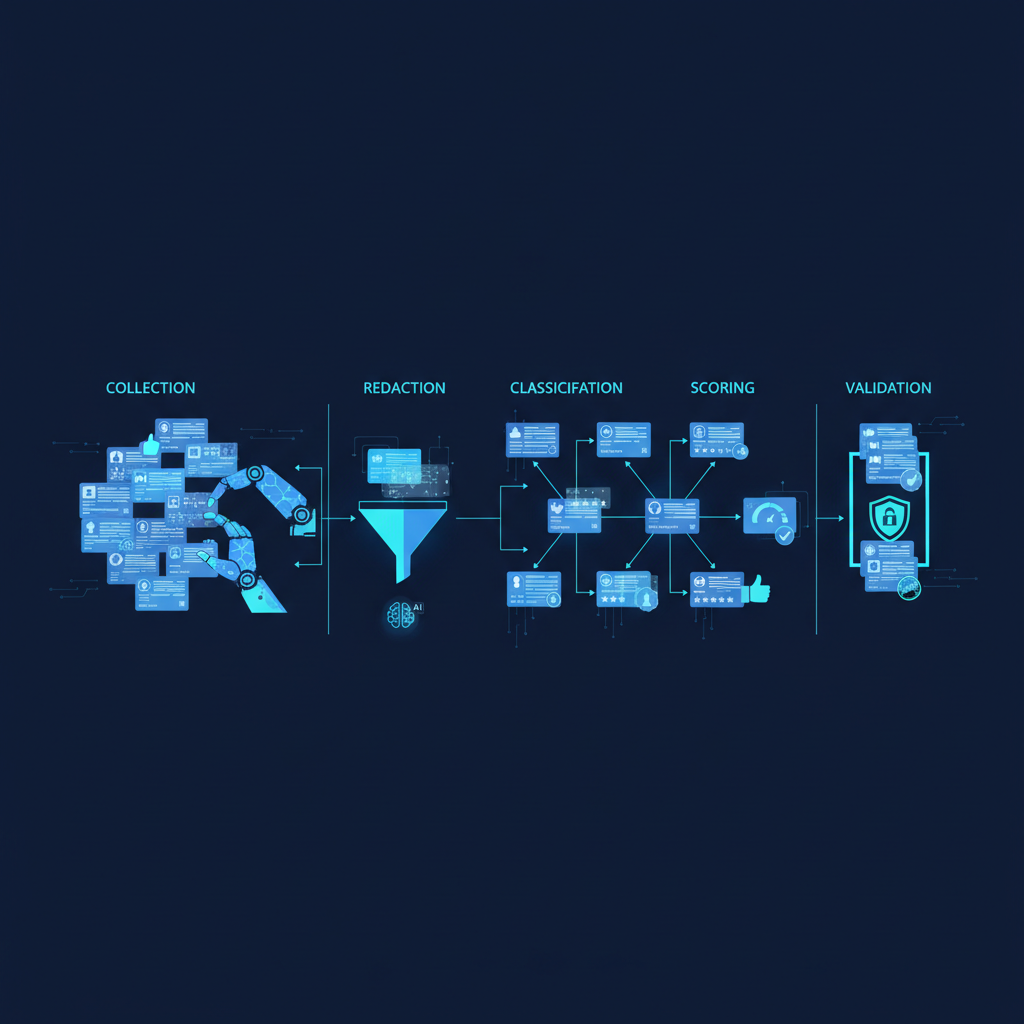
Use a Six-Step Workflow
- Define: Set the launch segment, category, geography, decision risks, and approved sources.
- Collect: Gather interviews, sales and support records, owned chats, site-search terms, public discussions, and search proxies.
- Protect: Redact unnecessary identifiers, document consent where needed, and apply the retention policy.
- Translate: Convert source language into natural prompts while retaining role, use case, objection, and qualifier.
- Classify: Add buyer-stage, comparison, integration, security, and purchase-risk tags.
- Validate: Score the library, review it with buyers and internal experts, then monitor the answers AI systems return.
| Prompt Record Field | What To Record |
|---|---|
| Prompt ID | Stable identifier for later review |
| Candidate Prompt | Natural question with qualifying context retained |
| Evidence Label | Observed Prompt, Observed Language, Search Proxy, or Modeled |
| Source | Interview, ticket, owned chat, public discussion, search data, or simulation |
| Source Date | Collection and review dates |
| Confidence | High, medium, or low, with a reason |
| Buyer Context | Role, use case, operating environment, and desired outcome |
| Decision Tags | Objection, comparison, integration, security, and purchase risk |
| Next Action | Validate, create, revise, monitor, or park |
This is the practical meaning of prompt-discovery definition: a documented process for turning buyer evidence into questions worth answering. It also gives smaller launch teams a manageable way to decide which pages deserve attention first.
Classify by Buyer Stage and Decision Risk
| Buyer Stage | What The Buyer Needs | Priority Tags |
|---|---|---|
| Problem Aware | Name the problem and its stakes | Role, use case, risk |
| Solution Aware | Compare approaches | Objection, integration, security |
| Category Aware | Assess category fit | Use case, comparison, budget risk |
| Vendor Evaluation | Validate a shortlist | Integration, security, purchase risk |
| Purchase And Implementation | Reduce adoption risk | Role, implementation, support concern |
The goal is not to manufacture a separate page for every row. A good library identifies clusters that deserve one complete answer, then records the qualifying questions that supporting sections, tables, or FAQs must address. That keeps the launch site focused while making important buyer context visible.
For teams with a limited site footprint, a small product-site AEO plan can help turn the highest-confidence clusters into a practical publishing sequence.
How to Prioritize and Validate the Library Before Launch
Prioritization should reward evidence and commercial importance, not the most fluent simulated question. A concise rubric helps a launch team explain why one prompt needs a security page now while another belongs in a future content backlog.
Score each candidate from zero to five on evidence strength, frequency, business relevance, answerability, and launch importance. Convert the ratings to a 100-point score using the weights below. These are transparent defaults, not universal research findings, so sales, product marketing, and SEO should approve them before collection begins.
Before applying the rubric, agree on the decision it is meant to support. A library for a broad awareness launch should not be scored exactly like a library built for an enterprise procurement page. The factors stay consistent, but teams can document why the launch assigns more importance to security, integration, or implementation certainty.
| Factor | Weight | What A High Score Means |
|---|---|---|
| Evidence Strength | 30 | Repeated, attributable first-party evidence or consented prompt data |
| Business Relevance | 25 | Direct fit with the target launch segment and commercial motion |
| Launch Importance | 20 | Needed to explain a key product, security, integration, or risk issue |
| Frequency | 15 | Repeats within a clearly labeled evidence source |
| Answerability | 10 | The team can publish a complete, substantiated answer now |
Use this formula: 30(E/5) + 25(B/5) + 20(L/5) + 15(F/5) + 10(A/5). Prompts scoring 80 or more belong in the launch set. Prompts from 60 to 79 need fast validation. Lower-scoring prompts remain visible in the backlog, with their provenance intact.
The rubric also improves handoffs between search and content teams. It makes clear whether a prompt needs a direct answer, a comparison table, a security explanation, an integration page, or a supporting FAQ. Our AI visibility and SEO tracking guide explains why a model response is a different signal from a conventional search ranking.
Before publishing, ask interview participants what they would ask next, ask sales whether the terminology fits live deals, and ask product or security reviewers whether the answer can be supported. Then run the highest-priority prompts in consistent, documented conditions and record the date, interface, exact prompt, response, cited sources, omissions, and factual errors.
Treat one response as a snapshot, not a verdict. Re-run important questions over time, compare the answer against the documented buyer need, and update the library when a model repeatedly surfaces a new criterion or exposes a missing explanation. The purpose is not to chase every variation. It is to keep the launch team accountable to what buyers can reasonably evaluate without a sales call.
For repeatable checks across important prompts, use an AI mention monitoring workflow instead of relying on a single screenshot.
Put the Method to Work with PageLens.ai
At PageLens.ai, we believe AI visibility work is only useful when a team can explain where each prompt came from and what it should do next. Our approach gives marketing, growth, SEO, and content leaders a shared way to maintain a buyer-question library, monitor the answers AI systems return, and connect important gaps to content work. That helps keep launch planning grounded in source language instead of speculative dashboards or one-off model outputs. Bring your existing interview notes, sales themes, site-search data, and target category. We will help you turn them into a documented prompt set with evidence labels, decision-stage tags, and a practical validation routine. When the launch team needs a clear view of what buyers may ask and how your information appears in AI answers, we can help make that work repeatable for every launch. Explore our platform or Book a demo
FAQs on B2B Buyer Prompt Research
Can a Tool See Private Buyer AI Chats?
No. A platform observes only prompts a buyer shares or sends through your consented environment. Treat all other chats as private and check visible answers separately.
What Counts as Observed Evidence?
Observed evidence is a verbatim question or language from an interview, sales call, support record, owned chat, site search, or public discussion with recorded provenance.
Is Search Data the Same as AI-Chat Prompt Data?
No. Search data shows queries people used in a search engine or on your site. It can suggest language patterns, but it does not reveal AI chats.
How Should Teams Handle Conversation Records?
Keep the original source reference, remove unnecessary personal details, record why you can use it, and retain only the excerpt needed to classify the question.
How Do Modeled Prompts Become Validated?
Model a candidate from evidence, preserve its constraints, label it clearly, then test it with buyers and reviewers. Promote it only when validation supports it.