.png)


TL;DR
We find that bank AI search visibility is becoming a distinct discovery problem: a May 2026 benchmark found bank-owned domains supplied under 7% of citations in its sampled banking answers. Banks should treat this as a directional visibility signal, not a deposit forecast, then monitor product, local, and recommendation prompts with controlled facts and compliance review.
Bank AI Search Visibility Lags in Customer Discovery
A public 2026 benchmark published May 13 analyzed 31,500 banking prompts across five AI products. Its most useful finding is not a league table, but a source problem: banks are often not the pages AI systems draw on when people research financial products.
Bank AI search visibility is lagging because sampled AI answers cited bank-owned domains less than 7% of the time, while three publisher sites supplied 68% of citations. That does not prove an AI answer causes an account opening, but it does show that banks can be missing at an early moment of customer consideration.
We examined what this signal does and does not establish, why local and product-specific prompts matter, and what marketing, SEO, and compliance teams should monitor next.
What the May Benchmark Actually Found
The study tested the 75 largest U.S. financial institutions and selected digital challengers between January and May 2026. It reported that 22 of the 75 large banks received less than 0.3% citation share, while one national institution held 28.4% of consumer-banking citation share. Those results are a snapshot of defined prompts and models, not a permanent ranking of consumer preference.
That distinction matters because an AI answer is assembled around a question, not a branch count or deposit total. In Google Search, AI Mode can break a question into subtopics and search them at the same time. A bank may therefore appear for a local small-business query, yet be absent from a broad comparison question about a savings product.
The immediate consequence is practical. Owned product pages, local information, and authoritative third-party coverage can all influence whether a bank is present in the answer a prospective customer sees first. Teams that only review traditional rankings may miss that source layer entirely.
Why Citation Share Is Not Deposit Share
A citation metric is useful when it is treated as evidence about sampled answers, not as a new proxy for market share. It can reveal recurring omissions, stale descriptions, and competing sources that shape a category conversation. It cannot independently demonstrate traffic, applications, deposits, or revenue.
Citation Share Is a Prompt Outcome
The same bank can receive different treatment when the user changes the product, city, eligibility profile, or wording. Model responses can also vary between runs. That makes a repeatable prompt set more valuable than a single visibility score, especially for regulated products whose rates and terms change.
We recommend retaining the exact prompt, answer date, engine, named institutions, recommendation wording, and cited sources. This turns an anecdotal result into an auditable record. Our guide to citation tracking explains how to capture the source layer alongside the answer itself.
Local Questions Can Create Openings
A separate market study analyzed more than 14,000 AI answers across 129 U.S. markets and found that about 62% of citations came from sources institutions did not own. Its central lesson aligns with the benchmark: question type, location, and product relevance can matter more than institution size.
For regional banks, that is not a reason to chase every generic “best bank” prompt. It is a reason to identify the local and product questions where the institution has a credible, current answer and where its source material is missing, unclear, or outdated.
Visibility Needs a Source Review
A bank should not assume that a citation is good news. An answer can name the institution while repeating an obsolete fee, omitting eligibility requirements, or relying on a source that no longer reflects the product. The source, the surrounding language, and the date matter as much as the mention itself.
That is why AI visibility reviews should separate three questions: Was the bank named? Was it recommended? Was the supporting information accurate and current? This approach is far more actionable than treating every appearance as equivalent.
How to Measure Bank AI Search Visibility
A disciplined measurement program starts with customer intent, then connects AI-answer observations to first-party search and conversion evidence. It should give marketing teams useful priorities without asking them to reverse-engineer opaque model systems.
Define a Prompt Portfolio
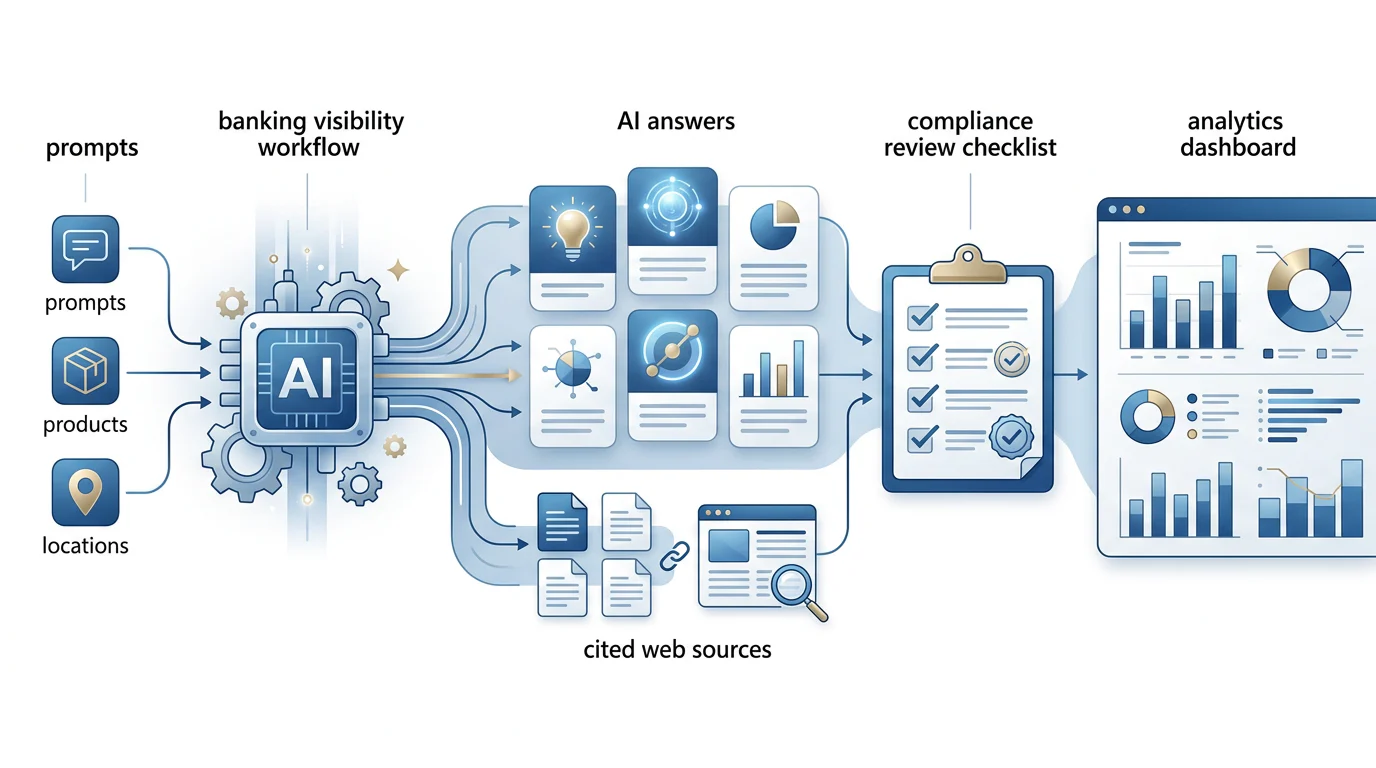
Build a baseline of 20 to 40 prompts across priority products, customer types, and markets. Include recommendation questions, eligibility questions, rate and fee questions, local-intent questions, and service questions. Record the same prompt wording each time so trend changes are interpretable.
Use cross-engine tracking to compare results by engine instead of collapsing unlike answers into one score. A prompt that matters for a mortgage prospect may have little relevance to a business-banking buyer, so reporting should retain that context.
Check What First-Party Reporting Can Show
Google now offers a generative-AI performance report for eligible sites. It shows impressions from AI Overviews and AI Mode by page, country, date, and device, though rollout is still limited for some properties. The Search Console report is useful evidence of Google visibility, but it is not a record of every AI answer or every source citation elsewhere.
Join that data to page-level conversion and application data. The goal is to learn whether pages that appear in generative search also help qualified visitors complete useful next steps.
Prioritize Facts over Formula Tricks
Google says its generative features rely on core Search ranking and quality systems, and its official guidance advises website owners to focus on useful, reliable, people-first content rather than supposed optimization hacks.
For banks, the priority list is straightforward: current product terms, transparent qualifications, clear market coverage, accessible pages, consistent structured information where appropriate, and a named process for reviewing material changes. Those are customer-information improvements first, and visibility improvements second.
What Bank Teams Should Do Next
The highest-value next step is not a large content program. It is a short, governed audit of the questions that already influence product discovery. Start with a product, a market, and a small set of prompts. Identify where the institution is omitted, where the answer cites a stronger source, and where the information needs correction.
Marketing should own the prompt inventory and reporting cadence. Product owners should verify product facts. Compliance and legal teams should define the review path for high-risk claims. The OCC guidance issued in April 2026 emphasizes risk-based governance and controls, a useful operating principle even though generative and agentic AI are outside that guidance’s scope.
Finally, use real customer language to choose what to test. Our prompt research workflow can help teams move from a broad AI visibility concern to a finite set of high-intent questions that can be measured, reviewed, and improved.
Build an Auditable Workflow with PageLens.ai
PageLens.ai turns a scattered review exercise into a documented operating rhythm for bank marketing teams. We help you define prompts by product, audience, and market; retain the answer, citation, recommendation language, and date; then focus reviewed work on the pages or external facts that are most likely to affect consideration. Our platform is not a promise of deposits or a substitute for legal review. It gives marketing, SEO, and compliance stakeholders a common evidence trail, so they can distinguish a temporary model variation from a recurring information gap. If your team needs an auditable baseline before the next product or rate change, Book a demo.
FAQs on Bank AI Search Visibility
What Does Bank AI Search Visibility Measure?
It measures how often defined AI answers name a bank, recommend it, or cite its pages and supporting sources, segmented by a consistent prompt set and market.
Why Can a Well-Known Bank Be Missing from AI Answers?
AI answers vary by product, location, wording, freshness, and available sources. A familiar bank can be absent when its information is less relevant to that question.
What Should a Bank Audit First?
Start with high-intent product and local prompts, then verify cited facts, owned-page accuracy, recommendation language, and generative-search impressions through repeated, documented reviews over time for each market.