.png)
PageLens.ai vs Writesonic for AI Monitoring
Compare PageLens.ai vs Writesonic for AI monitoring, including share of voice, one-site daily tracking, pricing, prompts, and content features.

PageLens.ai vs Writesonic for AI Monitoring
AI answer surfaces are becoming a measurable part of buyer research. OpenAI began a US 2026 ads test in February, reinforcing why marketers need to distinguish paid placements from the organic recommendations and citations buyers see.
For PageLens.ai vs Writesonic for AI monitoring, choose our Monitor plan when you need a simple 50-prompt, one-site ChatGPT baseline at $49 a month. Choose the broader suite when its three-engine tracking and content workflow will be used. For competitive share of voice and sentiment, compare our Optimize plan with the suite’s matching tier.
This comparison covers monitoring depth, setup, verified public pricing, prompt research, content capabilities, and the scenarios where each approach makes practical sense.
Verdict: PageLens.ai vs Writesonic for AI Monitoring
The right choice depends on what you are buying: a focused monitoring workflow or a broader SEO, content, and AI visibility suite. We built our entry plan for teams that want a daily answer-monitoring baseline without adding content production tools to the decision.
For marketing leaders, the most useful comparison starts with evidence: can you see the answer, the brands named, the cited sources, and the change over time? That is the core distinction between AI visibility tracking and conventional rank reporting.
| Comparison Field | PageLens.ai | Broader Suite |
|---|---|---|
| Entry monitoring price | $49 per month | $79 per month |
| Entry prompt allowance | 50 prompts | 50 prompts |
| Entry daily refresh | Yes | Yes |
| Entry engine coverage | ChatGPT | ChatGPT, Gemini, Google AI Overviews |
| Competitor and sentiment tracking | Listed on Optimize | Publicly documented, tier dependent |
| Content generation | Managed content on Growth | Included on Starter |
| Best fit | Focused, one-site monitoring | Teams using monitoring and content workflows |
The lower monthly cost is only meaningful when the scope also fits. A team that needs three engines on day one should not treat a ChatGPT-only baseline as an identical alternative. A team that only needs ChatGPT monitoring should not assume content tools add value simply because they are bundled.
How Deep Is the Monitoring Evidence?
Share of voice should be traceable to real answers, not treated as a score without a denominator. We center our workflow on the buyer prompt, the model response, the competing brands it recommends, and the sources it cites.

How Is Share of Voice Defined?
Our share-of-voice view shows how the recommendation splits between your brand and real alternatives in the prompt set. The broader suite defines share of voice as a brand’s share of total mentions relative to tracked competitors.
Those definitions can produce different readings of the same category. A recommendation share emphasizes who makes the shortlist. A mention share measures how often a name appears. Teams should document the prompt set, engines, dates, and competitor list before presenting either metric to leadership.
Can You Inspect the Underlying Evidence?
Our dashboard is designed to connect visibility movement to captured answers, cited sources, and the descriptive language models use. That gives a team something to review before deciding what to publish, correct, or leave alone.
The broader suite documents prompt-level views for answers that mention a brand and answers that do not, plus cited pages and platform filters. Its dashboard also supports citation share and rank-distribution reporting. For a deeper review of source-level analysis, see our guide to citation tracking.
What About Sentiment and Alerts?
Our Optimize plan publicly lists competitor and sentiment tracking. The broader suite documents positive, neutral, and negative sentiment analysis, but its current Starter plan does not list sentiment or alerts.
Alerts are useful when they direct someone to inspect evidence, not when they replace judgment. The broader suite documents email alerts for visibility and citation thresholds, while our public pages do not currently document exports or automated alerts. Teams that require either should confirm availability before purchasing. Our sentiment validation methodology is to review the phrase and answer context before acting on a label.
OpenAI states that ads operate in separate systems from ChatGPT answers. Monitoring should therefore distinguish an organic recommendation, a cited source, and a sponsored placement.
How Simple Is One-Site Daily Monitoring?
A simple setup is valuable when it produces a repeatable weekly workflow. It should not require a large reporting project just to answer whether your site appeared in the buyer questions that matter.
Our Monitor plan covers one site, 50 prompts, ChatGPT, daily refresh, and a single-site visibility dashboard. The broader suite’s Starter plan covers one project, 50 prompts, 50 daily answers, one market, and ChatGPT, Gemini, and Google AI Overviews.
Start with a Small Prompt Set
Begin with 50 buyer prompts that include category questions, comparison questions, replacement questions, and objections. Avoid treating a long keyword export as an AI prompt set, because a buyer may phrase the same concern differently when asking an assistant.
Use a one-site workflow to separate daily checks from the weekly work of reviewing missed prompts and cited sources.
Choose Engines Deliberately
Our Monitor plan is designed for a focused ChatGPT baseline. Our Optimize plan expands to ChatGPT, Google AI, and Perplexity. The broader suite’s Starter plan begins with three AI surfaces.
More engines are useful only when they reflect where your buyers ask questions. A smaller, well-maintained program can be more actionable than broad coverage that no one reviews.
Keep Reporting Close to Evidence
A weekly reporting workflow should answer four questions: Were we named? Who was named instead? What did the answer say? Which sources did it cite? That structure is easier to defend than a single abstract visibility score.
The broader suite documents dashboard presets, filters, daily and weekly trends, exports, and a Looker Studio connector. We show answer evidence, recommendation share, sentiment language, and sources in one workflow, while export and alert requirements should be confirmed with us during evaluation. For wider coverage planning, see our guide to multi-engine signals.
What Is the Total Cost for One Site and 50 Prompts?
For a one-site, 50-prompt daily baseline, our Monitor plan is $49 per month, or $588 over 12 monthly payments. The broader suite’s Starter plan is $79 per month, or $948 over 12 monthly payments.
That creates a $360 annual difference before considering engine coverage, reporting needs, content features, and any work a team will not use. Prices and plan details can change, so buyers should verify commercial terms at checkout.
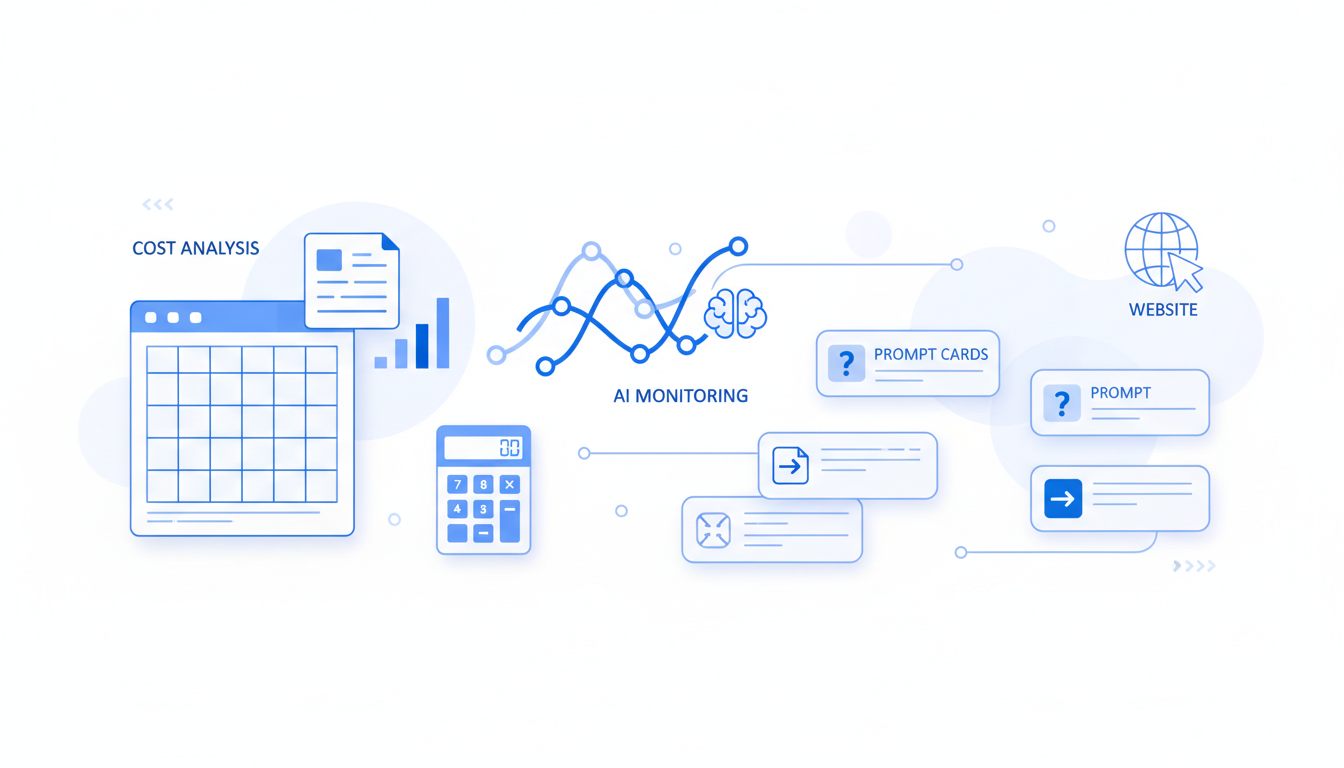
One-Site Daily Monitoring Worksheet
| Verified Public Input | PageLens.ai Monitor | Broader Suite Starter |
|---|---|---|
| Sites or projects | 1 site | 1 project |
| Tracked prompts | 50 | 50 |
| Daily refresh | Yes | Yes |
| Answer engines | ChatGPT | ChatGPT, Gemini, Google AI Overviews |
| Monthly price | $49 | $79 |
| Annualized monthly cost | $588 | $948 |
| Included content workflow | No managed content listed | 15 articles per month listed |
Matching the Richer Monitoring Scope
Our Optimize plan is $199 per month and includes 100 prompts, daily refresh, ChatGPT, Google AI, Perplexity, competitor tracking, and sentiment tracking. The broader suite’s Basic plan is also publicly listed at $199 per month with 100 prompts and 300 daily answers.
That is where feature-level comparison matters more than the entry price. Use a 100-prompt comparison when the team must evaluate evidence access, engines, competitors, sentiment, exports, alerts, and operational effort together.
Trials, Cancellations, and Refunds
Our site offers a free visibility audit, while paid monthly subscriptions are non-refundable. You may cancel at any time to prevent renewal, and eligible annual subscriptions may receive a prorated refund when requested within 30 days.
The broader suite publicly lists a no-card free trial, a seven-day refund policy, and cancellations that take effect at the next billing cycle. These terms can affect a short evaluation, but they should not outweigh a mismatch in the monitoring scope.
Do You Need Prompt Research and Content Generation?
Prompt research and content generation solve different problems. Research helps a team find the buyer questions worth tracking. Content capabilities help the team publish a response after it finds a gap. Monitoring proves whether the gap still exists.
We provide buyer-prompt discovery alongside monitoring, so teams can identify category questions before choosing a fixed prompt set. The broader suite documents prompt exploration, search-volume research, brand exploration, content strategy, article generation, and site optimization features.
When Prompt Research Matters
Use prompt research when the team cannot confidently name the questions buyers ask before they shortlist options. It is especially useful for commercial category prompts, implementation objections, and replacement questions that do not appear in ordinary keyword reports.
Our buyer-prompt research process starts with evidence from real buyer language, then turns that language into a monitored prompt set.
When Content Generation Matters
The broader suite is the better decision when one team will actively use its article writer, content strategy, optimization, and audit workflow. Those tools can reduce operational handoffs for a content-production program.
Our Growth plan includes managed content production, but we do not treat content production as a requirement for monitoring-first teams. The practical sequence is simple: identify the prompt gap, inspect the cited sources, publish a useful page, and measure whether the answer changes.
OpenAI expanded its ads system in a May 2026 update that introduced beta self-service purchasing and CPC bidding. That makes clear organic-answer evidence even more important when a buyer experience can contain both recommendations and paid placements.
Why PageLens.ai Fits Monitoring-First Teams
PageLens.ai is built for the question monitoring-first teams actually ask: what are buyers hearing about us, which brands are taking the recommendation, and what source earned it? We keep the workflow close to that evidence. Start with one site, select buyer prompts, and review daily answers, citations, visibility movement, and model language. When the program needs broader coverage, we can show the plan that matches it without forcing content production into a monitoring decision. For the workflow that follows evidence before production, see our content stack. Bring your current prompt list and target market. We will walk through the scope, cost, reporting needs, and work your team will actually use. We will also tell you if the lighter workflow is not the right fit before committing to a subscription or expanding monitoring scope. If the answer is PageLens.ai, Book a demo.
FAQs on PageLens.ai vs Writesonic for AI Monitoring
These answers focus on the purchasing decision for a monitoring-first team. They separate plan scope from bundled features that may not be relevant.
Is PageLens.ai Better for One-Site ChatGPT Monitoring?
For one-site ChatGPT monitoring, our $49 Monitor plan is the simpler baseline. Choose the broader suite only when its extra engine coverage and content workflow will be used.
How Does Each Platform Calculate AI Share of Voice?
Our share-of-voice view shows recommendation splits among your brand and alternatives across the selected prompt set. The broader suite measures your share of total mentions relative to tracked competitors.
Does the Lowest-Priced Plan Include Competitor Tracking and Sentiment?
Not on equivalent entry plans. Our Monitor plan lists a single-site visibility dashboard, while competitor and sentiment tracking appear on Optimize. Check the other tier grid.
What Should Teams Compare Beyond Monthly Price?
Compare site count, prompt limits, engines, refresh frequency, evidence access, exports, alerts, and required workflows. That prevents a low entry price from hiding important monitoring gaps.