.png)
Search for the ‘best’ KiwiSaver shows reality is a slippery concept to AI engines - thepost.co.nz


TL;DR
We explain why The Post’s 17 August 2026 “best KiwiSaver” AI-search report is a visibility lesson, not a universal investment ranking. For PageLens.ai readers, the useful response is to define prompts, preserve citations and settings, publish primary evidence, and measure changes across engines before acting on apparent AI-search gains.
Search for the ‘best’ KiwiSaver shows reality is a slippery concept to AI engines - thepost.co.nz
KiwiSaver held $123 billion at 31 March 2025, so a vague recommendation can carry real weight for readers. We examine what a reported AI-search test means for marketers responsible for accurate, visible content in high-stakes categories.
AI search visibility for a “best KiwiSaver” query is inherently conditional: the answer can change when an engine interprets a different saver profile, uses different live sources, or applies a different retrieval method. SEO teams should measure the exact prompt, response, citations, locale, and time, then publish source-backed criteria instead of claiming an unsupported universal winner.
What Happened When “Best” Met KiwiSaver AI Search
Google News recorded the relevant report at 16:00 UTC on 17 August 2026. The News record describes a search for the “best” KiwiSaver as evidence that reality becomes slippery when AI engines answer broad recommendation prompts.
The Post report is a timely visibility signal, not proof that one provider is objectively superior or that an AI answer is financial advice. Its useful lesson is narrower: a superlative prompt conceals the criteria that would make an answer testable.
That distinction changes how we should read a result. A person planning a first-home withdrawal, a person close to retirement, and a person investing for decades do not necessarily need the same fund characteristics. An answer that skips those differences may sound decisive while still answering an incomplete question. This is why prompt research should begin with the decision a reader is actually trying to make.
Why “Best” Is Not a Fixed KiwiSaver Fact
The official comparison framework makes the ambiguity visible. Sorted currently displays 396 funds and asks users to assess risk profile, fees, services, and historical performance before deciding what is suitable, rather than treating a search result as a universal ranking. Its fund comparison lets users compare funds within relevant categories.
Suitability Comes Before a League Table
“Best” must first mean best for whom, over what timeframe, with what tolerance for volatility, and for which goal. If those conditions remain unstated, an AI system has to infer them, and different inferences can produce different recommendations without any one output being a reliable universal answer.
| Input | What It Changes | Evidence A Reader Needs |
|---|---|---|
| Time horizon | Appropriate exposure to growth assets | Stated goal and expected withdrawal date |
| Risk tolerance | Acceptable volatility and asset mix | A documented risk assessment |
| Fees | Long-term cost to the member | Current fee disclosure and balance assumptions |
| Service needs | Value of support and communications | Comparable provider service information |
| Historical returns | Context for past outcomes | Like-for-like category and period comparison |
Fees and Returns Answer Different Questions
A fund’s fee is a current, measurable cost. A return is a historical outcome that may not repeat. Sorted warns readers not to choose a fund solely because it recently performed well, and its selection guidance places risk level, fees, services, and consistent performance in that order.
The Scale Raises the Editorial Standard
For publishers and financial brands, the consequence is not to avoid the topic. It is to make the conditions legible. A useful page can explain how readers compare choices, name the data date, distinguish education from personal advice, and link to the underlying disclosures without manufacturing a winner. A structured buyer prompt method makes those hidden conditions visible before teams evaluate visibility.
What the Reporting Confirms, and What It Cannot Prove
The reported event confirms that broad “best” prompts are worth monitoring because they can shape a reader’s first impression. It does not establish a permanent search ranking, a universally correct recommendation, or a stable citation set across engines.
Search-enabled AI products can alter the query before retrieving results. The official search documentation explains that a system may rewrite a question into one or more targeted searches, which is enough to make prompt wording a material part of the test.
Google also says AI Overviews and AI Mode can use different models and techniques, meaning their responses and links may vary. Its AI feature guidance is a useful reminder that a link appearing once is evidence of that answer instance, not a permanent rank.
For financial content, we should also keep the advice boundary clear. The FMA notes that online recommendations of specific financial products may amount to regulated advice, so the strongest content explains criteria, limits, sources, and uncertainty instead of impersonating a personalised adviser.
A source record should remain attached to every monitored result. Teams that need to review what an answer actually cited can use our guide to source context to keep the answer, URL, and recommendation language together.
How AI Search Visibility Changes Search Engine Optimisation
Search engine optimisation still starts with useful, crawlable, reliable information. What changes is the measurement problem: an AI result is assembled from a prompt, a retrieval path, an answer format, and a time-specific set of sources. Google’s current guidance says foundational SEO best practices remain relevant for generative search features.
Build a Prompt Library Around Decisions
A keyword such as “best KiwiSaver” is too broad to be a test plan. Break it into decision contexts, including time horizon, goal, location, definition of value, and evidence requested. The resulting library should capture wording readers genuinely use, including follow-up questions that clarify what the original query left unspecified.
Track Citations with the Answer
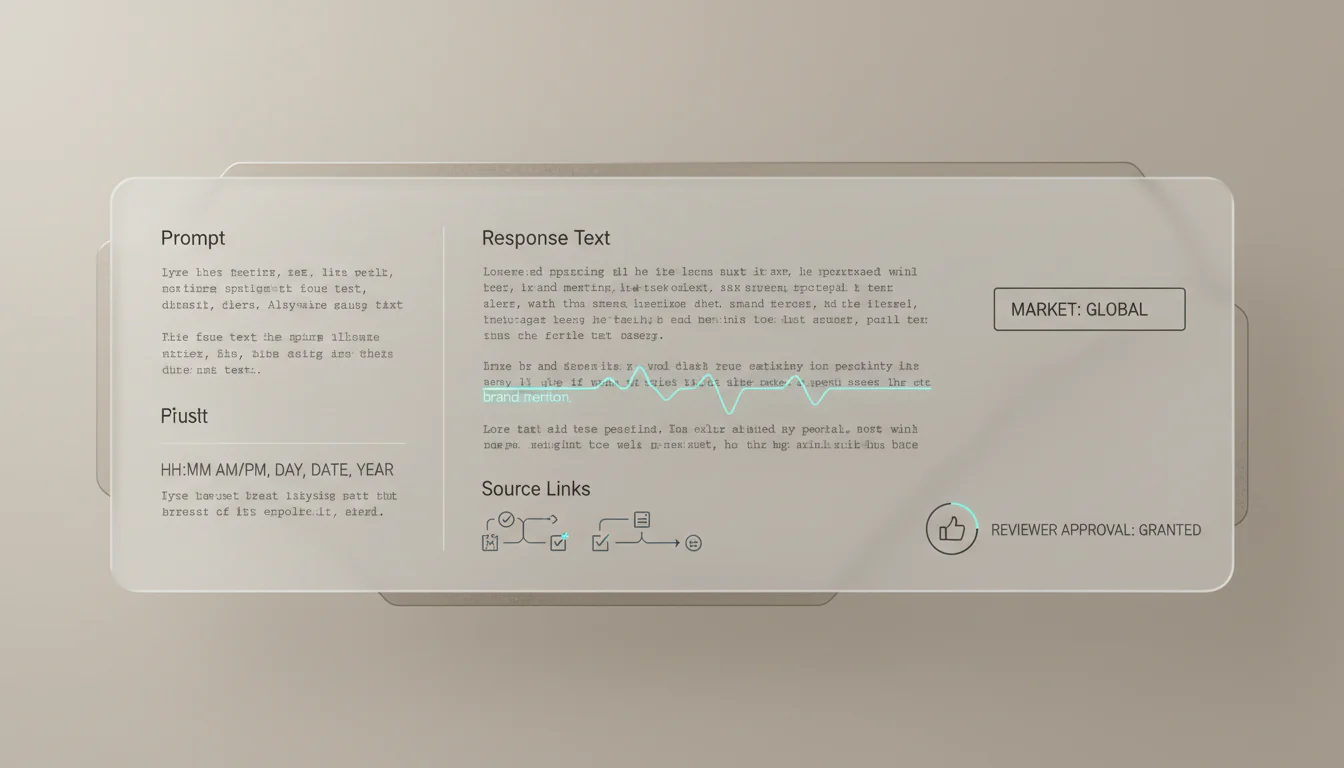
A mention without its surrounding wording can mislead a team. Record the full response, the cited URLs, whether the answer recommended, compared, or merely named a brand, and the precise prompt that produced it. That record should be readable by editorial, legal, and analytics owners without asking them to reconstruct a result from screenshots.
Compare Engines Without Pretending They Are Identical
Different systems may retrieve different pages, phrase uncertainty differently, or decline to make a recommendation. That is why cross-engine monitoring should surface patterns, not force every output into one ranking. Use multi-engine tracking to compare defined prompts while preserving the differences that matter.
A Reproducible Method for “Best” Prompts
A credible test is simple enough to repeat and detailed enough to audit. Start with the exact language a reader would use, then document the conditions under which an answer appeared. Google’s generative reporting update also reinforces the need to separate visibility in Google’s generative features from visibility elsewhere.
Capture the Minimum Evidence
| Record | Minimum Capture | Why It Matters |
|---|---|---|
| Prompt | Exact wording and follow-up | Reveals the question actually tested |
| Engine context | Product, mode, locale, and date | Makes a rerun comparable |
| Answer | Full response, not a summary | Preserves caveats and framing |
| Citations | Every linked source URL | Shows the evidence path |
| Recommendation language | Exact wording and position | Distinguishes a mention from an endorsement |
| Re-test | Same settings on a schedule | Identifies real changes over time |
The collection process should preserve the raw answer before a team turns it into a dashboard metric. It should also retain source URLs in their original order, since sources can reveal whether an engine treated an official document, a publisher, or a commercial page as the answer’s evidential foundation. Our guide to answer tracking explains how to connect an observed answer to a specific content decision.
Test the Conditions Behind the Superlative
A robust test does not use one superlative prompt as a proxy for an entire category. Test the variants separately: best for a stated timeframe, lowest cost, best recent performance, strongest service support, or best fit for a defined need. Each prompt has a different fact pattern and may call for different authoritative evidence.
Before comparing results, document whether the test used search, what country the search operated in, whether the session was personalised, and whether any follow-up question changed the result. Repeating the same conditions matters because a change in sources, context, or retrieval route can look like a visibility gain when it is only a change in the experiment.
Turn Findings into Content Actions
When a test reveals missing definitions, stale data, weak sourcing, or unclear ownership, fix the page before chasing more mentions. Use a repeatable visibility measurement process to record the change, refresh the evidence, and test again under the same conditions.
How PageLens.ai Makes AI Search Visibility Measurable
At PageLens.ai, we help marketing, growth, and SEO leaders turn AI search visibility into a reviewable operating process. Our work starts with a controlled prompt set, then retains the response, sources, recommendation language, locale, and run time so teams can see whether a change is real or merely a different answer instance. We use that evidence to prioritise pages that need stronger definitions, original data, clearer comparison criteria, or better source support. We do not turn a fluctuating answer into a score that pretends certainty. Instead, we give your team a defensible trail from a buyer prompt to its citations and the content action it suggests. That gives editorial, analytics, and compliance owners a shared record before they make a claim, brief a rewrite, or report progress to leadership. Read our methodology, bring your high-stakes prompt set, and Book a demo.
FAQs on AI Search Visibility
Why Can AI Engines Answer “Best” Queries Differently?
Because the prompt leaves crucial conditions unspecified, including timeframe, risk, source freshness, and what “best” means. Different retrieval paths can therefore surface different, defensible evidence.
Is an AI Citation the Same as a Ranking?
No. A citation records one answer at one moment. It does not prove permanent prominence, factual accuracy, user trust, or equivalent visibility in other engines.
What Should Teams Record When Testing AI Answers?
Record the exact prompt, engine, search mode, locale, date, response, cited URLs, mention position, and recommendation wording. Repeat the same test regularly to detect material changes.
Does Ordinary SEO Still Matter for AI Search Visibility?
Yes. Accessible pages, accurate information, clear ownership, original evidence, and genuinely useful explanations still matter. AI search adds a measurement layer without replacing SEO fundamentals.