


TL;DR
Compare ChatGPT rank trackers for multi-site SEO by prompts, site controls, reporting, and eight-site costs.
In OpenAI’s 2025 analysis, ChatGPT had been used weekly by more than 700 million people. For agencies and SEO teams, the problem is not checking one answer once. It is keeping client evidence separate while seeing the portfolio clearly.
ChatGPT rank trackers for multi-site SEO should separate each client’s prompts, competitors, citations, and reporting while still giving operators one portfolio view. This comparison covers the metrics, access controls, workflows, and eight-site costs that determine whether a tracker remains useful after the second client.
What ChatGPT Rank Tracking Means
A ChatGPT tracker does not report a traditional search position. It samples a defined prompt, captures the answer, and records whether the client appears, where the client appears in a list when a list exists, and which sources the answer cites. That makes a repeatable prompt setup more important than a single attractive score.
This distinction matters because ChatGPT Search can search the web, reformulate queries, and display cited sources. The ChatGPT Search documentation also makes clear that there is no guaranteed top placement. A useful tracker therefore preserves the prompt, engine, date, locale, verbatim answer, mention, citation, and response order together.
For portfolio reporting, define the metrics before collecting data:
- Mention Rate: The percentage of tracked answers that name the client.
- Citation Rate: The percentage of answers citing the client’s owned domain.
- Response Position: The client’s order in a ranked recommendation response. Mark unranked prose as not applicable.
- Sentiment: The language used to describe the client, retained with the original answer for review.
- Share Of Voice: The client’s mentions divided by all tracked brand mentions in the same prompt set, engine, market, and period.
That evidence is why AI visibility versus SEO needs its own workflow. A conventional keyword position cannot show whether an answer omitted a client, described it inaccurately, or cited a third-party source instead of the client’s site.
What Multi-Site Teams Require
A tracker becomes a portfolio system only when aggregation does not destroy client separation. Every site needs a dedicated prompt library, alternative set, market configuration, response history, users, and export boundary. Otherwise, an operator cannot tell whether a change belongs to one SaaS client or reflects a wider category shift.
Each site also needs a reliable record of the pages an answer cites, so operators can distinguish a lost brand mention from a lost owned-domain citation. Keeping that evidence at the client level makes the reporting trail easier to review.
The same applies to access. A client should see its own prompt evidence, citations, and reports without seeing another client’s data. Meanwhile, the agency team needs a cross-site view to spot patterns, allocate work, and intervene when a meaningful visibility loss occurs. Google notes that AI answer experiences can use different models and techniques, so their answers and supporting links can vary, according to Google’s AI guidance.
Before choosing a platform, use this operating checklist.
| Portfolio Requirement | What To Verify | Why It Matters |
|---|---|---|
| Site separation | Distinct workspaces, prompts, alternatives, and exports | Prevents cross-client data leakage |
| Prompt governance | Tags, owners, markets, and change history | Keeps comparisons valid over time |
| Permissions | Client, operator, manager, and admin roles | Limits access without blocking delivery |
| Portfolio reporting | Roll-up dashboard with site-level drilldown | Lets leaders see both trends and causes |
| Distribution | Scheduled reports, CSV or PDF exports, alerts, and API access | Reduces manual reporting work |
| Offboarding | Data export, access removal, and history retention rules | Makes client transitions auditable |

For an eight-client program, prompt research must be standardized before automation begins. A shared taxonomy for commercial, comparison, implementation, and category prompts gives the portfolio a common language while protecting each client’s individual strategy. Start with buyer prompt research, then assign prompt ownership before reports go out.
How ChatGPT Rank Trackers for Multi-Site SEO Compare
The best ChatGPT rank tracker for multiple websites is not necessarily the platform with the most engines or the lowest starting price. The decisive question is whether the product can run eight separate programs without forcing the team into eight disconnected dashboards, a shared competitor list, or manual report assembly.
Compare products on public capabilities, then ask for contract-level confirmation where a vendor does not document permissions, workspace limits, white-label reporting, retention, or APIs. A feature marked as available on a sales call is not the same as a published entitlement.
Measurement Fidelity
A tracker should capture evidence instead of merely calculating a score. Ask whether it keeps the complete answer, cited URLs, named alternatives, response order, sentiment language, and the prompt version that produced the result. Without these fields, a week-over-week movement can be impossible to explain.
Engine coverage also needs context. More engines can broaden the view, but each engine needs its own sampling rules and reporting filters. Use multi-engine signals to avoid treating results from different answer systems as one interchangeable ranking.
Portfolio Controls
For client work, the minimum standard is separate websites, prompt sets, markets, tracked alternatives, users, and exports. A portfolio overview should summarize those sites without combining their source evidence or visibility metrics into a misleading blended number.
Check the operational controls directly:
- Workspace Boundaries: Confirm that one client cannot view another client’s prompts, citations, or reports.
- Prompt Ownership: Confirm who can add, edit, archive, and approve prompt changes.
- History Retention: Confirm whether prompt changes preserve historical context.
- Offboarding: Confirm how a client’s evidence and access are exported or removed.
Reporting and Commercial Fit
Reporting-heavy operations need scheduled delivery, clear date ranges, client-safe exports, alerts, and a path to warehouse or API access when reports become part of a larger analytics process. Small portfolios may not need every enterprise control, but they still need evidence that is defensible when a client asks why a recommendation disappeared.
Where citation evidence needs close inspection, use source tracking to preserve the answer, source, date, and client context together.
| Tracker Type | Strength | Portfolio Constraint To Test | Best Operational Fit |
|---|---|---|---|
| PageLens.ai | Daily answer evidence, sources, visibility, sentiment, and share of voice | Confirm multi-site reporting and access requirements during scoping | Teams that want tracking connected to content action |
| Single-Site Tracker | Focused setup and lower entry cost | May require separate subscriptions and manual portfolio reporting | One brand or a small, independent client set |
| Broad SEO Suite | Existing SEO workflow and reporting familiarity | AI visibility may be an add-on with separate prompt limits | SEO teams consolidating tools |
| Sales-Quoted Platform | Potentially deeper controls and custom support | Public pricing and plan limits may be unavailable | Reporting-heavy or complex deployments |
This becomes a commercial question, not a slogan. “Unlimited” has little value if prompt capacity, user permissions, exports, or client reporting still create separate costs.
How Portfolio Workflows and Costs Differ
An eight-site program requires 800 prompts when each client tracks 100 prompts. That is enough volume to expose weak governance quickly: an unapproved prompt change can distort trends, a shared alternative list can corrupt share of voice, and a missing export rule can create client-data risk.
On our published pricing page, we list single-site plans with clear prompt and engine coverage. The normalized figures below multiply those public monthly rates by eight sites. They show why entry price alone is not a portfolio cost.
| Our Plan | Prompts Per Site | Engine Coverage | Eight-Site Monthly Cost | Fits 800 Prompts |
|---|---|---|---|---|
| Monitor | 50 | ChatGPT | $392 | No |
| Optimize | 100 | ChatGPT, Google AI, Perplexity | $1,592 | Yes |
| Growth | 100 | All available answer engines | $4,792 | Yes |
| Enterprise | Custom | Custom | Custom | Quote Required |
The table does not turn every other platform into a comparable dollar figure, because public starting prices rarely establish eight-site prompt limits, paid add-ons, or white-label reporting rights. A fair comparison includes the plan needed for domains, prompts, engines, users, reporting, API access, and brandable exports.
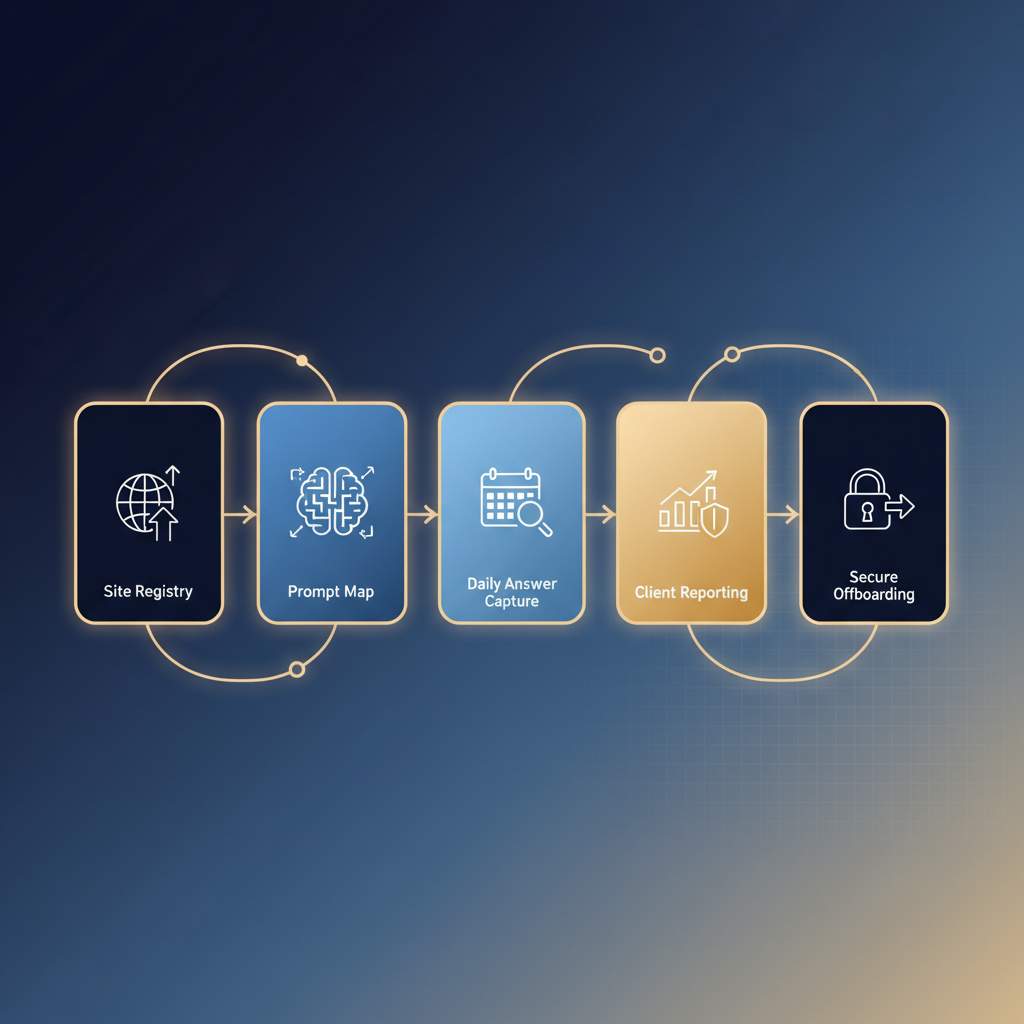
Five-Step Portfolio Onboarding
- Register Each Site: Record the domain, market, reporting owner, client users, alternatives, and offboarding contact.
- Build Prompt Libraries: Map prompts to buyer intent and assign tags, locales, owners, and approval status.
- Capture A Baseline: Run the same prompt configuration consistently and save mentions, citations, response position, sentiment, and answer text.
- Route Reports And Alerts: Give clients site-only access, while operators retain the portfolio view and receive change alerts.
- Review And Offboard: Review prompts monthly, version changes instead of overwriting history, then export evidence and revoke access when work ends.
This workflow turns tracking into a managed service rather than an expanding spreadsheet. A disciplined mention workflow also makes it easier to explain why a score changed and what the team will do next.
Which Operation Needs Which Tool
Small portfolios should buy for clarity. If one person manages one to three sites, a focused tracker with enough prompts and a clean evidence trail may beat a sophisticated platform that creates unused administrative work. The goal is not an enterprise dashboard. It is a reliable baseline and a repeatable report.
Growing SEO teams need the next layer: site separation, prompt governance, portfolio dashboards, client-safe exports, and alerts. At this point, the cost of manual consolidation often matters more than the difference between two starting prices. Teams should test their real prompt set, not a generic product demo.
Reporting-heavy operations should require formal permissions, data isolation, scheduled exports, documented retention, and a commercial answer on API or white-label needs. The useful decision test is whether the platform supports how the team already serves clients, including onboarding and offboarding.
| Operation | Best Fit | Non-Negotiable Requirement |
|---|---|---|
| Small Portfolio | Focused single-site monitoring | Enough prompts for meaningful buyer questions |
| Growing SEO Team | Portfolio tracker with distinct workspaces | Cross-site reporting without client data exposure |
| Reporting-Heavy Operation | Configurable deployment with formal controls | Permissions, exports, retention, and documented support |
If you are still validating one domain, begin with a single-site guide. If your operation already has several clients, choose the system that makes portfolio evidence easier to govern, not merely easier to view.
PageLens.ai for Multi-Site AI Visibility
PageLens.ai is for teams that need to turn AI answers into an operating loop, not another disconnected dashboard. We capture daily answer evidence across the engines buyers use, show the sources behind those answers, and help teams move from missed prompts to publishable work on their own domains. For a portfolio, start by bringing an eight-site prompt map, each client’s competing alternatives, market settings, reporting owners, and the approval rules that determine who can see what. We will use that information to scope coverage honestly, including prompt volume, engine mix, historical views, reporting cadence, and any required client separation. Use our deployment checklist to test whether a platform fits your operating model before comparing entry prices across each client today. If you need a clear view of how AI describes every client and where it cites them, Book a demo.
FAQs on ChatGPT Rank Trackers for Multi-site SEO
Portfolio decisions depend on evidence quality, practical permissions, and the ability to explain cost. These answers cover the questions teams ask before moving from one-site monitoring to client portfolio operations.
What Does a ChatGPT Rank Tracker Measure?
It samples defined prompts, records brand appearances, saves cited sources and response order, then measures changes within the same engine, locale, prompt version, and reporting period.
How Should Client Data Be Separated?
Use separate workspaces, prompt libraries, alternatives, markets, roles, and exports for each client. The portfolio dashboard can aggregate totals without exposing another client’s evidence or data.
How Many Prompts Does an Eight-Site Portfolio Need?
For eight sites, start with 100 prompts per site only when each prompt maps to a business decision. Expand after monthly reviews identify meaningful coverage gaps.
Why Is a Starting Price Not Enough?
A starting price is not a portfolio cost. Include the plan needed for domains, prompts, engines, users, reporting, API access, and white-label reporting before buying a tracker.