
Which Phrases Shape Your AI Brand Sentiment? Phrase-Level AI Sentiment Analysis


TL;DR
At PageLens.ai, we treat AI brand sentiment as evidence, not a dashboard label. Phrase-level AI sentiment analysis preserves complete model responses, classifies contextual claims, and traces every trend to its prompt, engine, model, date, and exact language so marketing teams can validate what deserves action.
A useful sentiment system has to handle what language hides in plain sight. One study found that about 30% of reviews conveyed sentiment without obvious opinion words, which is why keyword spotting alone misses important context in implicit sentiment research.
Phrase-level AI sentiment analysis explains a brand score by preserving the exact model language behind it. We collect complete answers, isolate brand-relevant phrases with context, assign targets, themes, polarity, and confidence, then connect every aggregate to its prompt, engine, model, date, and source response. That makes the score inspectable instead of merely persuasive.
The method below shows what to keep, how to classify difficult language, how to compare results over time, and how to audit a dashboard number back to a single answer. It is built for marketing, growth, SEO, and content leaders who need evidence before they act.
Which Phrases Shape AI Brand Sentiment?
AI brand sentiment is shaped by claims about a brand’s strengths, weaknesses, risks, fit, and limitations. A response can be favorable about one feature and skeptical about the brand’s suitability, so the whole answer should never receive one blunt label.
Start with a stable set of buyer questions. If the prompt set changes every week, the trend can reflect new questions rather than a changed narrative. Teams that need a repeatable starting point can build a buyer prompt dataset before they compare any labels.
| Verbatim Phrase | Target | Theme | Polarity | Why It Matters |
|---|---|---|---|---|
| “A dependable option for regulated teams” | Brand | Compliance | Positive | A favorable suitability claim |
| “Includes approval controls” | Feature | Workflow | Neutral | A description without evaluation |
| “Powerful, but difficult to configure” | Feature | Implementation | Mixed | Both clauses must remain visible |
| “One reviewer calls pricing opaque” | Reviewer | Pricing | Attributed | The source claim is not automatically the model’s view |
The target matters as much as the wording. “Its documentation is thin” concerns a feature, while “it is not a fit for small teams” is a suitability claim about the brand. “According to a reviewer” adds attribution, and “the prompt assumes it is expensive” says something about the question, not necessarily the answer.
How Are Complete AI Responses Collected and Preserved?
Collection begins before sentiment analysis. We run a defined prompt set across the engines that matter to the audience, preserve the complete answer, and record the conditions under which it appeared. The work is more than scraping a snippet because a phrase without its prompt, source response, and run details cannot be checked later.
For each response, retain the prompt text, engine, model when exposed, run date, locale when relevant, full response, cited sources shown, and a durable response ID. A team that needs broader coverage can monitor mentions across engines, but the same collection fields should apply everywhere.
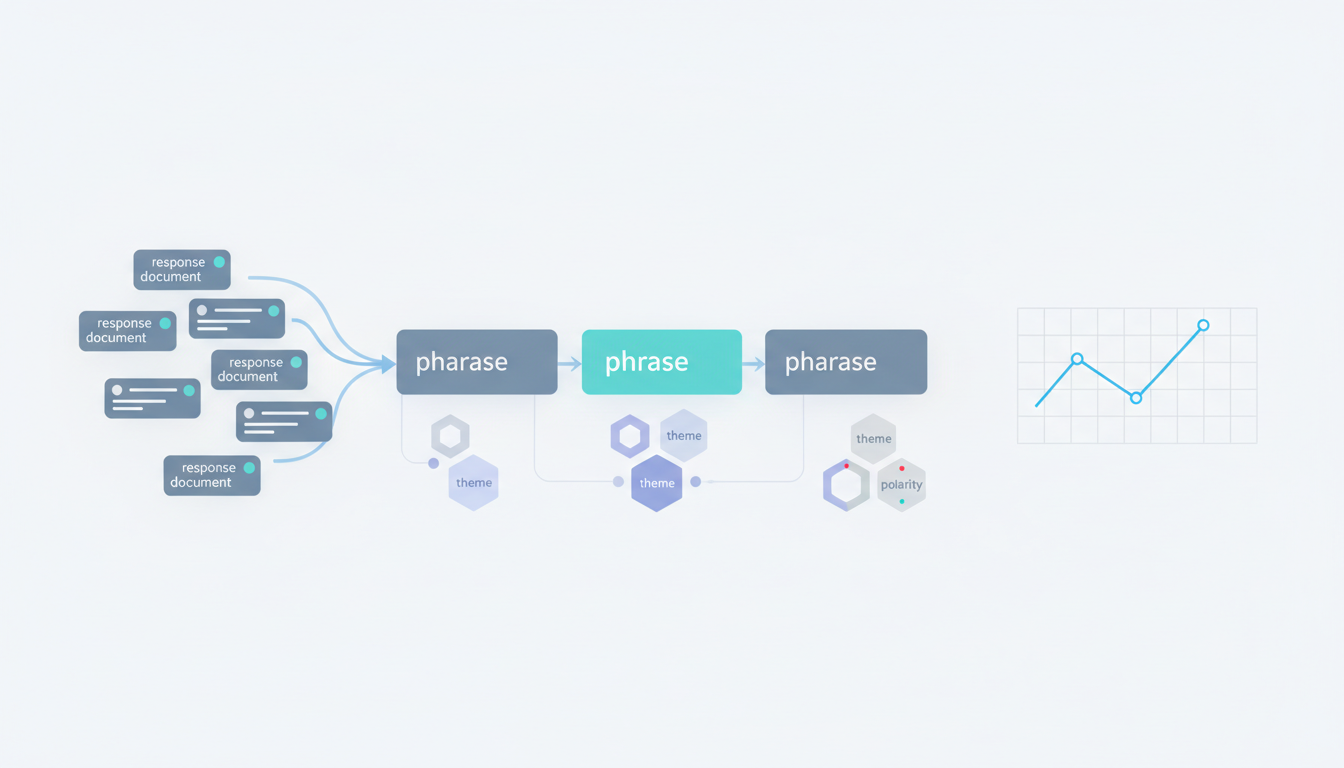
Raw responses should remain immutable while annotations remain versioned. This lets reviewers see whether the language changed, the extraction logic changed, or a human corrected a label. NIST recommends documented, repeatable evaluation methods and ongoing monitoring in its AI risk framework, a sound standard for any measurement system people will use to make decisions.
How Does Phrase-Level AI Sentiment Analysis Extract and Label Evidence?
The extraction step should identify the smallest meaningful claim while keeping enough surrounding language to preserve its scope. Phrase-level AI sentiment analysis is not a hunt for positive adjectives. It is targeted interpretation of model language, including qualifiers, comparisons, attribution, and negation.
Research on contextual polarity shows why a phrase needs disambiguation before it receives a label. The same word can be neutral in one setting and evaluative in another, which is the central problem addressed by phrase-level research.
Keep Qualifiers, Negation, Comparisons, and Attribution
Do not extract “easy to use” from “easy to use after a lengthy implementation.” Preserve “not,” “only,” “for,” “compared with,” and “according to” because each changes the claim. Keep a short context window with the verbatim phrase so a reviewer does not have to reconstruct its meaning.
Identify the Claim Target Before Polarity
Every record should identify whether the sentiment targets the brand, a feature, a cited reviewer, or the prompt itself. This prevents a negative comment about setup time from becoming a negative brand score, and prevents an attributed review from becoming an unqualified model conclusion.
Combine Automation with Review
Deterministic rules can match names, aliases, quotations, and explicit exclusions. Classifiers can propose targets, themes, polarity, and confidence at scale. Human review should resolve mixed, comparative, sarcastic, unsupported, and low-confidence language. Our AI sentiment tracking architecture explains where those layers belong between an answer and a report.
| Example Response Language | Target | Label | Validation Rule |
|---|---|---|---|
| “A strong choice for compliance-heavy teams” | Brand | Positive | Clear favorable evaluation |
| “It has audit logs” | Feature | Neutral | Descriptive only |
| “The onboarding is frustrating” | Feature | Negative | Clear unfavorable evaluation |
| “Excellent reporting, but expensive for small teams” | Brand and feature | Mixed | Preserve both claims |
| “A reviewer says it is overpriced” | Reviewer | Attributed | Keep source and do not imply endorsement |
| “Great, if you enjoy weeks of configuration” | Feature | Review Required | Possible sarcasm or mixed meaning |
How Do Themes and Trends Stay Auditable Across Engines?
Themes make a large evidence set usable, but they should not erase disagreement. Group records into a controlled taxonomy such as pricing, implementation, support, integrations, compliance, or suitability. Then retain every phrase beneath each theme, including phrases that point in opposite directions.
A theme trend becomes credible when it uses the same prompt cohort, displays its response and phrase counts, and lets readers filter by engine, model, period, target, polarity, and review status. Use cross-engine answer tracking to establish comparable conditions before treating any difference as a market signal.
| Comparison Dimension | Engine Or Period A | Engine Or Period B | Evidence Needed |
|---|---|---|---|
| Prompt Cohort | Same tracked questions | Same tracked questions | Prompt IDs and prompt text |
| Response Volume | Complete response count | Complete response count | Run dates and response IDs |
| Theme Distribution | Counts by theme and polarity | Counts by theme and polarity | Linked phrase records |
| Mixed Claims | Preserved separately | Preserved separately | Context and reviewer decision |
| Trend Interpretation | Directional change | Directional change | Matched collection conditions |
A score should not conceal a split narrative. If one engine praises implementation speed while another repeatedly flags complexity, report both patterns instead of averaging them into neutrality. NIST describes measurement as a mix of quantitative and qualitative methods with documented uncertainty and reporting, a useful standard for repeatable measurement.
How Do You Audit a Sentiment Score from Start to Finish?
A score is defensible only if a marketer can travel backward from the total to the evidence. Teams can validate brand sentiment before acting on a trend, especially when the result will shape content, product, communications, or SEO decisions.
Use this five-step workflow whenever a score informs a decision:
- Freeze The Prompt Cohort: Record the questions, engines, dates, locale, and collection settings before comparing periods.
- Preserve Complete Responses: Store each full answer and its response ID before extraction or normalization.
- Extract Contextual Phrases: Capture verbatim language, context, target, theme, polarity, confidence, and annotation version.
- Review Exceptions: Escalate ambiguous, mixed, comparative, sarcastic, attributed, and unsupported claims for human decisions.
- Recompute And Drill Down: Confirm that a displayed score can be recalculated from the saved records and traced to each source response.
When a number changes, first check the evidence base: prompt coverage, response count, model conditions, and classification changes. Then inspect the underlying claims. Use this process to audit exact model language before treating a single phrase as the explanation for a broader trend.
How Does PageLens.ai Support Evidence-First Sentiment Audits?
At PageLens.ai, we help marketing, growth, SEO, and content leaders make AI visibility decisions from evidence they can inspect. We begin with the questions buyers actually ask, preserve the response behind each result, and keep the path from phrase to trend clear for the people accountable for action. That approach helps teams distinguish a recurring product concern from a one-off model claim, a reviewer’s opinion, or a prompt that introduced its own bias.
Use this method to decide what deserves a content update, a product explanation, a source correction, or no action at all. Our team can walk through a practical audit design that fits your prompt set, reporting cadence, and review process. We focus on transparent records, not a mysterious label or assumptions alone in daily decisions. Learn more about PageLens.ai. If you want to make every sentiment conversation more defensible, Book a demo.
FAQs on Phrase-level AI Sentiment Analysis
Is a Sentiment Score Enough?
Not by itself. A score needs searchable phrases, complete responses, prompts, engines, dates, targets, and label decisions so your team can inspect what produced it.
What Should a Phrase-Level Record Include?
At minimum, retain the exact phrase, enough surrounding context, its target and theme, polarity, confidence, source prompt, engine, model, date, response ID, and review status.
How Should Mixed Claims Be Labeled?
Keep the favorable and unfavorable clauses intact, label the record mixed, identify the target of each claim, and avoid converting disagreement into a neutral average.
How Can Teams Compare Engines Fairly?
Use an identical prompt cohort and record engine, model, locale, date, and response count, then compare aggregated labels with underlying evidence available for review later.
When Is Human Review Necessary?
Human review is most valuable for mixed, comparative, sarcastic, attributed, unsupported, or low-confidence language, plus sampled high-confidence labels used to test the classifier regularly.