.png)
AI Assistants Are Choosing Local Businesses for Your Customers: What Search Engine Journal Reported About Local AI Visibility


TL;DR
We found that the January 8, 2026 Search Engine Journal warning describes a real shift, but not a published universal formula for local recommendations. Google and ChatGPT now support location-aware discovery and actions, so we explain the evidence, limits, and a practical measurement workflow for local AI visibility.
AI Assistants Are Choosing Local Businesses for Your Customers: What Search Engine Journal Reported About Local AI Visibility
Local discovery is entering AI interfaces, although it is not replacing every conventional search journey overnight. In a 2026 survey of 5,119 U.S. adults, 42% said they use chatbots to search for information, according to Pew research.
On January 8, 2026, Search Engine Journal published a webinar-led warning about AI assistants selecting local options. The confirmed reality is that Google can show local business information and call relevant U.S. businesses, while ChatGPT Search can tailor local results with location. Local AI visibility therefore requires accurate data and recurring, location-specific testing, not a published AI ranking formula.
We examine what the original report said, what primary sources independently confirm, and how marketing, growth, SEO, and content leaders can measure the local answers customers actually receive.
What Happened on January 8
The original article framed a useful question for local businesses: when a customer asks an assistant for a nearby provider, does the business appear in the answer? Its central warning was that weak or inconsistent local information can make a business easier to skip. The source itself was a webinar invitation, published January 8, rather than a new platform announcement or a disclosed study with a universal recommendation model. That distinction matters when interpreting the SEJ report.
We should not dismiss the warning because its format was promotional. We should narrow the claim to what can be verified. Major AI-assisted search products now present local options, use location to tailor responses, and create paths from a recommendation to a call, direction request, booking, or purchase. What remains undisclosed is the exact weighting used to generate each shortlist.
That makes the event less dramatic than “a new algorithm chose the winners overnight,” but more operationally important. Teams must separate product behavior from inference, then build a baseline around the prompts and places that matter commercially. This is also why prompt research vs keyword research changes the work: a ranking keyword alone does not capture a buyer’s detailed local request.
What AI Products Actually Do for Local Discovery
The evidence supports a clear change in the customer journey. Instead of seeing only a long results page, a user may receive a synthesized response that selects details, names local options, and presents an immediate action. That can shape consideration before a customer visits a business website.
Google AI Mode Can Present Local Business Details
Google documented that AI Mode can show local place cards with ratings, reviews, opening hours, live busyness, call options, and directions. Its example described a local shopping query that returns nearby stores and useful context for deciding where to go. That is direct evidence that local business information can appear inside an AI-led search experience, as described in Google’s AI Mode.
Agentic Calling Can Contact Relevant Businesses
Google also introduced a U.S. agentic-calling feature for nearby shopping queries. Users can request an availability check, select questions, and receive a summary after Google calls relevant businesses. The announcement was first posted November 25, 2025 and updated July 24, 2026, making the connection between accurate local information and AI-mediated customer action more concrete through agentic calling.
ChatGPT Search Can Use Location for Local Results
ChatGPT Search can use approximate location from a user’s IP address and, when enabled, precise device location to improve local recommendations. Its documentation says the service may rewrite a request into more targeted local queries and use location context to improve relevance. That supports localized answers, but it does not disclose a fixed formula for which business is named first in its search documentation.
| Surface | Confirmed Behavior | What We Can Measure |
|---|---|---|
| AI-led search | Local business cards, reviews, hours, and actions can appear | Whether a brand appears, what facts appear, and which action is offered |
| Agent-assisted shopping | Relevant businesses can be contacted for user-requested information | Whether availability, contact details, and service facts are correct |
| Location-aware chat search | Location can tailor local requests and responses | Whether answers vary by city, prompt, and location permission |
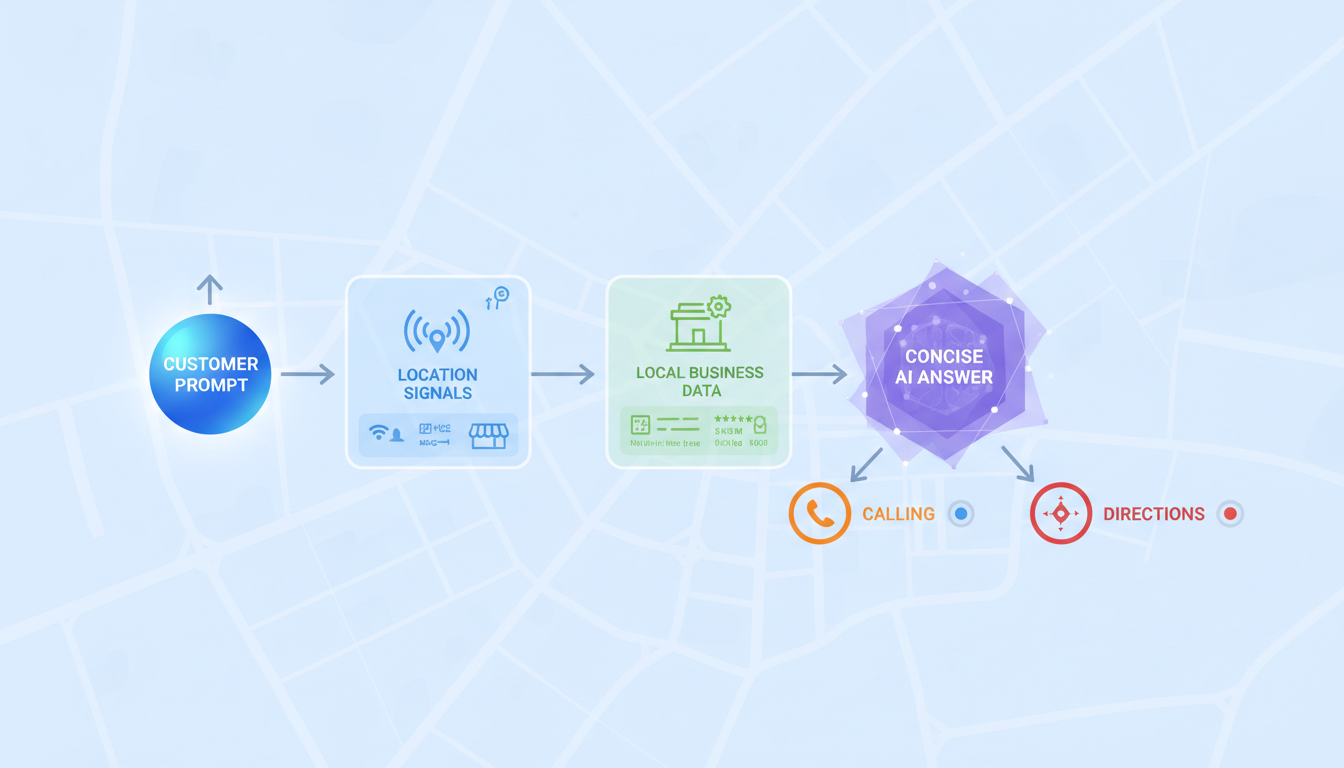
The practical implication is not that traditional local search has vanished. It is that brand visibility now needs to include the answer itself, the source context, and the accuracy of the business facts in the answer. For teams building that practice, citation tracking context is as important as counting whether a name appeared.
What Local AI Visibility Does Not Promise
We should be precise about the limits of the evidence. Google publicly describes local Search and Maps results as driven mainly by relevance, distance, and prominence. It also says complete business information can improve a profile’s chance of appearing, while reviews and positive ratings can help local ranking. Those are documented local-search principles, not a published formula for every AI-generated local response in Google’s guidance.
That boundary is useful. A business cannot responsibly promise that schema, reviews, or a listing update will cause every assistant to recommend it. Location, intent, availability, freshness, user context, and each product’s retrieval behavior can alter an answer. Treating a single test as a universal rank is a category error.
What teams can control is the quality and consistency of evidence available to systems and customers. Google’s LocalBusiness documentation supports publishing structured facts such as location, hours, and business type, then validating that markup and keeping pages crawlable. We recommend connecting those technical checks to actual answer testing, not presenting them as a shortcut to guaranteed inclusion.
A focused AI citation tracking guide can help teams connect the local facts they publish with the sources an answer engine actually surfaces.
A strong program also needs evidence outside a single product or market. Recommendation visibility should be examined in the context of the specific prompts and local category a customer uses.
How We Measure Local AI Visibility
A credible workflow starts by treating each answer as an observation with conditions, not as a permanent ranking. We begin with markets that matter to revenue or have known data-quality risk, then define the local intents customers actually use. This approach turns broad anxiety about AI search into a testable operating process.
Build a Prompt and Location Baseline
Create a fixed set of discovery, comparison, availability, and reputation prompts for each priority market. Record the city or ZIP context, date, device setting, and wording before running the tests. That structure prevents a team from comparing two answers produced under different conditions and calling the difference a performance change.
The prompt set should reflect buyer behavior, not just a spreadsheet of head terms. Use the evidence-first methods in AI buyer prompt research to identify the questions prospects ask before they contact a local business.
Capture Four Observable Outcomes
For every tested answer, record whether the business was mentioned, how it was described, which sources were surfaced, and whether its factual details were correct. If an answer returns a shortlist, also capture order while noting that order can change with location and time.
| Measurement | How To Record It | What It Reveals |
|---|---|---|
| Mention presence | Named, not named, or ambiguously referenced | Basic inclusion for a defined prompt and market |
| Recommendation language | Exact descriptors and qualifiers used | The reason a business may be considered relevant |
| Citation context | Linked source, listing, or cited page | Which evidence the answer made visible |
| Factual accuracy | Hours, address, services, availability, and contact details | Customer-risk issues that need correction |
Cross-product comparisons need the same discipline. A cross-engine tracking method helps ensure that one score does not hide meaningful differences between markets, prompts, or answer formats.
Prioritize Accuracy Before Content Volume
Google reported that its Maps ecosystem published more than 1 billion helpful reviews and received 80 million suggested updates to business hours and contact information during 2025. It also blocked or removed 292 million policy-violating reviews, 79 million inaccurate or unverified edits, and more than 13 million fake Business Profiles. Those figures illustrate why local business information is a living data set, not a one-time publishing task, as shown in this Maps update.
When answers contain wrong hours, old addresses, missing service details, or misleading recommendation language, resolve those factual problems first. Then assess whether service pages, location pages, structured data, and review processes support the same accurate representation. Ongoing brand visibility monitoring makes it easier to distinguish a data defect from ordinary answer variation.
How PageLens.ai Turns Observations into Action
At PageLens.ai, we help marketing, growth, SEO, and content teams replace occasional screenshots with a repeatable view of how their brand appears in AI answers. Our approach starts with the evidence that matters: the prompt, market, location context, answer, source, recommendation language, and factual accuracy. We use those observations to show where visibility breaks, whether the answer is wrong, and which content or data issue deserves attention first. That matters for multi-location teams because one strong national result can hide weak local representation. We do not treat a mention as a conversion claim or a single score as the whole story. We help teams build a measurement cadence using our PageLens methodology that can stand up in planning meetings, content reviews, and local operations. If your team needs an auditable starting point for local AI visibility across every priority market for this quarter, Book a demo.
FAQs on Local AI Visibility
What Is Local AI Visibility?
Local AI visibility is how reliably a business appears, is accurately described, and is cited when assistants answer relevant local-intent questions for a defined market.
Does Local SEO Guarantee Inclusion in AI Answers?
No. Strong local search foundations improve machine-readable evidence, but platforms do not publish a shared recommendation formula or guarantee inclusion in conversational local answers today.
How Should Teams Measure Local AI Visibility?
Test a fixed prompt set by city, record the answer and cited sources, verify factual accuracy, then compare mention rate and wording against a dated baseline.
Which Locations Should We Test First?
Start with localities that drive meaningful revenue or have known data problems, then expand once your team can review answers, facts, sources, and follow-up actions consistently.