.png)
PR Firm News: Pollack Group Launches Brand Visibility Index, What It Means for AI Visibility


TL;DR
On August 17, 2026, O’Dwyer’s reported Pollack Group’s new Brand Visibility Index, whose initial study analyzed 335 AI-generated answers to 20 back-to-school prompts. We explain what the study found, what its short sampling window cannot prove, and how teams can track AI visibility with a repeatable evidence-based workflow.
PR Firm News: Pollack Group Launches Brand Visibility Index, What It Means for AI Visibility
AI-generated answers are becoming a material discovery surface for brands. In WFA research, 96% of 27 participating brands said AI-generated search would have a transformational or significant effect on how consumers find and choose them.
On August 17, 2026, O’Dwyer’s reported that The Pollack Group launched its Brand Visibility Index, beginning with a six-retailer back-to-school study. Its primary report examined 335 AI-generated answers from 20 shopper prompts, which makes the release a useful AI visibility snapshot, not a universal ranking or proof of causation.
We unpack the confirmed timeline, the study’s actual results, its methodological limits, and a practical way to use this kind of evidence without treating one short measurement window as settled fact.
What Happened on August 17
O’Dwyer’s report said The Pollack Group launched a research series examining how brands are represented, ranked, and cited in generative AI answers. Its first edition focused on back-to-school retail questions, particularly the kinds of dorm-shopping prompts students and parents might ask.
The important date distinction is simple. The trade-publication coverage ran on August 17, while the underlying study was published four days earlier. The index is framed as a recurring research series, not as an official ranking system maintained by AI platforms themselves.
That distinction matters for marketers. A well-defined prompt set can reveal where a brand appears, what language accompanies the mention, and which sources are cited. It cannot, by itself, establish how every user, prompt, geography, or model version will behave. Our AI visibility benchmark uses the same principle: useful comparisons need a declared scope before they become decision-ready.
What the Inaugural Study Actually Measured
The primary study analyzed 335 AI-generated answers collected from July 27 through August 3, 2026. It used 20 prompts about dorm essentials, furniture, shopping, and deals, and examined six retailers: Amazon, Bed Bath & Beyond, IKEA, Target, The Container Store, and Walmart.
The Reported Awareness Results
The study defined awareness as the percentage of analyzed answers that mentioned a brand. Target and IKEA each appeared in about 30% of the sampled answers, while Amazon, the next-highest brand by that measure, appeared in 8.7%.
| Measure | Reported Result | What It Describes |
|---|---|---|
| Awareness | Target and IKEA: about 30% | Share of sampled answers naming each brand |
| Awareness | Amazon: 8.7% | Share of sampled answers naming Amazon |
| Share Of Voice | Target: 12%, IKEA: 11%, Amazon: 3.3% | Brand mentions divided by total brand mentions |
| Mention Position | IKEA: 2.4 average position | Average order of appearance in answers |
| Owned-Page Citation | IKEA dorm page: 27% | Sampled answers citing that specific page |
Those figures are meaningful inside the defined sample. They are not a declaration that one retailer permanently outranks another across every AI answer surface.
The Cited-Source Pattern
The report found that social platforms were frequently cited. It reported Reddit at 32%, YouTube at 19%, and Instagram at 16% among cited domains. It also noted citations from mainstream editorial outlets and from brand-owned pages, particularly purpose-built content related to the exact shopping occasion.
That is a useful prompt for teams to inspect their own source environment. Instead of asking only whether a site ranks, ask which third-party sources and owned pages appear when buyers ask category-specific questions. Strong prompt research starts with real language and intent, then connects those prompts to observable answers.
What the Results Suggest, Not Prove
The report argues that a dedicated, relevant page can be more visible in AI answers than a much larger general catalog. That is a plausible interpretation of the sampled answers, but it remains an interpretation. The study did not run a controlled experiment that changed one page while holding every other source, prompt, and model condition constant.
For content leaders, the durable lesson is more modest and more useful: create clear evidence-rich pages for high-value situations, then test whether those pages and their supporting sources actually appear in relevant answers.
What the Data Confirms and What It Cannot Prove
The launch, publication dates, prompt count, answer count, retailer set, and reported metrics are verifiable from the publisher’s materials. The results should still be described as publisher-reported observations from a short collection period, rather than independent proof that a specific tactic causes a specific visibility outcome.
That caution is not academic nitpicking. A 2026 measurement paper found that AI-search answers can vary across runs, prompts, and time, making a single observation unreliable as a complete performance assessment. A brand can gain or lose mentions because of prompt wording, source changes, model behavior, regional context, or ordinary output variability.
The most defensible interpretation separates three things:
- Confirmed event: The trade report covered the index launch on August 17, 2026.
- Publisher-reported findings: The study observed specified mention, source, and sentiment patterns within 335 answers.
- Editorial analysis: We believe the study supports repeated prompt-level measurement, but it does not establish a permanent category hierarchy.
That separation keeps a team from overreacting to one dashboard movement. It also improves citation context, because the cited source, answer wording, and prompt conditions remain attached to every conclusion.
How to Turn AI Visibility into a Repeatable Workflow
A useful measurement program begins before anyone opens an AI tool. Teams need a fixed set of high-intent prompts, a clear definition of what counts as a mention or citation, and a record of the conditions under which each answer was collected.
The IAB’s measurement framework similarly emphasizes that brands and publishers need consistent ways to evaluate visibility in AI-powered discovery. Without that shared structure, a single number can conceal changes in prompt mix, source quality, or answer wording.
Build a Prompt Set Around Real Decisions
Start with 20 to 30 prompts that reflect buying, comparison, problem-solving, support, and category discovery. Include the wording customers use, not only the phrases a team wishes they used.
Cross-engine evidence should not be flattened into a single result. Our multi-engine tracking guidance explains why the engine, answer format, and source pattern should remain visible during review.
Record More Than a Single Score
A useful scorecard distinguishes appearance from prominence, source support, and portrayal. The table below creates a repeatable structure without pretending that every output can be compressed into one number.
| Metric | Practical Definition | Decision It Supports | Guardrail |
|---|---|---|---|
| Mention Rate | Percentage of sampled answers naming the brand | Find prompt coverage gaps | Do not call it a universal rank |
| Share Of Voice | Brand mentions divided by all brand mentions | Compare category presence | Keep prompt sets consistent |
| Mention Position | Average order of appearance | Evaluate prominence | Compare similar answer formats |
| Citation Rate | Percentage of answers citing relevant sources | Prioritize source work | Review citation accuracy |
| Portrayal | Exact recurring recommendation and sentiment language | Detect narrative drift | Preserve full answer context |
Prompt selection should be grounded in evidence, not only internal brainstorming. Reviewing buyer-prompt data can help teams identify the questions that deserve recurring measurement and the terms that change a buyer’s intent.
Repeat, Review, and Respond
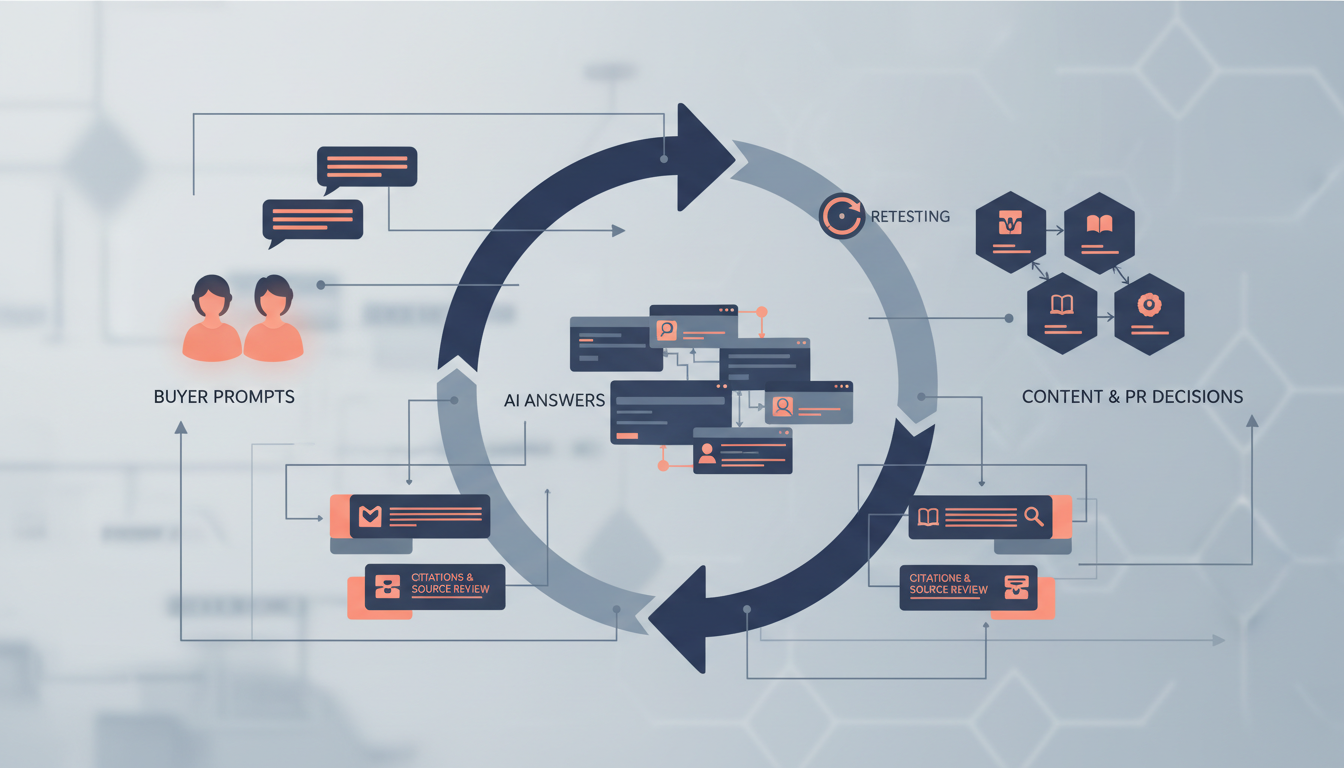
Run the same prompt set on a defined cadence and after material events, such as launches, major coverage, pricing changes, or reputation issues. Preserve the full answer alongside its sources, date, engine, and the exact prompt so a later comparison remains meaningful.
When a shift appears, investigate before changing content. Read the answer, inspect the cited sources, identify whether the issue is factual, editorial, or contextual, and then decide whether a page update, PR action, or watchlist is warranted. A repeatable measurement system turns that work into a shared operating habit instead of a reaction to isolated screenshots.
How We at PageLens.ai Turn AI Visibility into Action
At PageLens.ai, we help marketing, growth, SEO, and content teams turn scattered AI answers into a repeatable evidence base. Our approach starts with the prompts buyers actually ask and the facts a brand can substantiate. From there, we help teams review mentions, citations, recommendation language, and source context before deciding whether a page, PR brief, or factual correction needs attention. We keep the work practical: agree on the prompt set, identify an owner, document the evidence, review changes on a schedule, and retest after meaningful events. This turns a vague score into a decision process for growth and reputation. That gives leaders a clearer basis for prioritizing what needs verification, improvement, or a careful response in their work. Explore our platform when you are ready to build a durable review system with confidence across teams today, then Book a demo.
FAQs on AI Visibility
When Did the Brand Visibility Index Launch?
O’Dwyer’s covered the launch on August 17, 2026. The underlying back-to-school report was published August 13, after collecting answers from July 27 through August 3.
Does a 30% Mention Rate Mean a Brand Is Number One?
No. The rate reflects appearances within one defined set of prompts, retailers, engines, and dates. It cannot establish a stable category ranking or prove why brands appeared.
How Should Teams Use AI Visibility Findings?
Start with buyer prompts, capture full answers and citations, repeat tests across engines, then review source quality and narrative accuracy before making content or PR decisions.